BLOG

Check out the Explorevolcanoes BLOG


Volcanic eruption Casestudies 

Volcanic eruptioon casestudies of some of the worlds most famous volcanic eruptions. Choose from Merapi in Indonesia,Mt St Helens 1980,Montserrat and Soufriere Hills Volcano,Eyjafjallajokull and the Iceland Ash Cloud,Nevado del Ruiz / Armero and Ruapehu in NewZealand.

  • Merapi
  • Mt St Helens
  • Montserrat
  • Unzen
  • Eyjafjallajokull
  • Kilauea
  • Nevado del Ruiz
  • Ruapehu

Merapi: Indonesia

Where is the volcano?

Map of selected volcanoe in Indonesia USGSMerapi volcano is part of the Pacific Ring of Fire on the border of Central Java and Indonesia. It is 28 km north of Yogyakarta city (population 1.5 million) but the slopes are populated too . The volcano is 1968m (9738 ft) tall . Some villages are located as high as 1700m.

Why is there a volcano here?

Merapi is one of 129 volcanoes in Indonesia situated above a subduction zone where the Indo-Australian plate is sinking beneath the Eurasian Plate. The volcano is around 400 000 years old.

Eruption Style

Merapi is a stratovolcano built up of layers of ash and lava. Initially 400 000 years ago the volcano mainly erupted basaltic lavas and erupted effusively. In the last 10 000 years the volcano has become more explosive and has generated pyroclastic flows from andesitic lava domes. Pyroclastic flows have also been generated from eruption column collapse. 

Recent Eruptions 2006

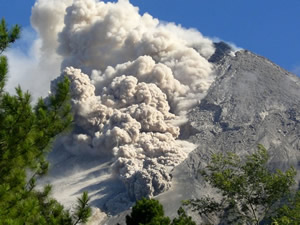
Merapi Pyroclastic flow 2006In April 2006 seismic activity indicated that new magma was rising within the volcano and that eruptions were very likely. Through the rest of April villages were prepared for evacuation and ash clouds were rising up to 4000m. During May lava flows appeared and on the 11th May and 17000 people were evacuated.Some people decided to stay to look after their crops and animals. On mAy 27 th a large earthuake to the south killed 5000 and displaced 200 000, During June lava and pyroclastic flows caused 11 000 people to be evacuated to escape the pyroclastic flows.

Hazard Management 2006

The evacuations were relativley successful as only 2 people were killed as a direct result of the eruption. Merapi is a closely monitored volcano and currently has 8 seismometers from which the location of earthquaes can be found. a zone of no earthquakes 1.5km below the summit has been deduced as the magma chamber.Tiltmetres measure the inflation and deflation of the volcano.

2010 Eruption

Merapi pyroclastic flow 2010Increased seismic activity in September heralded the beginning of a new eruptive phase. White plumes were seen rising above the crater and the lava dome began to inflate.Frequent earthquakes continued and lava began to flow in late October. People were evacuated from a 10km exclusion zone, this affected 19000 people but is unclear how many complied. The magma rose to 1000m below the summit. 153 people had died by November 10th and 320 000 people had left their homes. By 24 November 324 people had lost their lives mostly from burns sustained in pyroclastic flows .The longest flows reached 9 miles from the summit.By Dec 3rd deaths had reached 353 but the alert level was lowered but still with the risk of eruption clouds.

Lahars flowing down the Code river into the centre of Yogyacarta were asignificant threat.Some areas of the city suffered from lahars .

280,000 who normally live on the fertile slopes of the volcano took refuge in 700 emergency shelters. There reports of poor sanitation, and not enough toilets or clean drinking water. More than 2,000 homes were destroyed, 350,000 people evacuated,airports closed and hundreds of international flights cancelled to and from Indonesia. Financial losses are estimated at US$781 million.

Hazard Management

Merapi eruption damge and evacuees ReutersVolcanic Hazards in Indonesia are managed by the National Disaster Mitigation Agency(BNPB)in conjunction with the Centre for Volcanology and Geological Hazard Mitigation (PVMBG). They are responsible for monitoring, issuing alert levels and evacuation orders. In remote and rural areas with srong cultural links to the volcano it can be impossible to ensure that all are evacuated . This reflected in the death tolls from pyroclastic flows.However an estimated 20 000lives were saved by the successful evacuations.

Why not look at our World volcanoes section or Volcanic Hazards page.

Cascade Subduction Zone USGSMt St Helens:USA

Where is the volcano?

Mt St Helens (8365 ft , 22,550m) is in the Cascade Volcanic Range in Washington State, USA. The Cascade Range has 160 volcanoes and Mt St Helens is considered the most active, and lies 100 miles south of Seattle and 50 miles from the coast at Portland.

Why is there a volcano here?

Mt St Helens is a stratovolcano within the Cascade Volcanic range in Washington State and had been dormant for 100 years prior to 1980. As an Eastern remant of the Pacific Plate, the Juan da fuca plate,has subducted beneath continental North America the Cascade volcanic chain has formed. The Mt.St.Helens volcano has been active for around 40,000 years but the now damaged cone we see today has formed over the last 2,200 years

Eruption Style

Cascade Subduction Zone USGSThe volcano is highly explosive and erupts in the Plinian style like Vesuvius. Sudden violent explosions are accompanied by towering clouds of hot ash, dust and rocks thrown high into atmosphere. Pyroclastic flows and volcanic mud flows called Lahars flow down the mountain at speed and consume the surrounding landscape. lavas from basalt to andesites have been erupted forming layers of ash and lava. In many stratovolcanoes a central summit crater has dome of dacitic lava which is squeezed out of the main vent , similar to Montserrrat. In 1980 this did not occur and instead a crypto dome formed (crypto means hidden) causing the Northern slope of the volcano to bulge and grow. From mapping the deposits around the volcano it seemes that lateral blasts and side domes were not unprecedented.

Sequence of Events

On May 18 1980 Mt.St.Helens produced an enormous lateral blast which obliterated everything for 20 miles north of the volcano. The summit decreased from 2930m to 2550m and a gaping crater 1.5km wide was created.

Mt St Helens Crypto Dome on the north flank USGSThe sequence of events that occured had not been witnessed before as until then geologists had always seen volcanoes erupt upwards but this was different this was sideways!

In March 1980 earthquakes and a phreatic(steam) 2km eruption column alerted the USGS that the volcano was certainly waking up. Throughout the spring the mountain continued to splutter and steam the northern side of the mountain was bulging out by 1.5m/day. A 5 miles exclusion zone was placed around the volcano and famously Harry Truman owner, of the Spirit lake lodge resort, refused to leave.

On the morning of May 18 Geologist David Johnson was on a ridge 10km north of the volcano when a 5.1 earthquake struck. Suddenly the bulge on the north side of the volcano slid downwards in a massive landslide at 300km/hour and crashed into Spirit lake causing an enormous wave of water the rest of the landslide ploughed down the Tootle river valley and mixed with vast quantities of lake water and ice . Davids last message was to his colleagues in the nearby Vancouver USGS base ( not Canada) "Vancouver,Vancouver .. this is it!"

Mt St Helens May 18 1980The landslide uncorked the magma in the crypto dome and released the pressure. The gas in the magma instantly expanded and shattered the rocks at supersonic speed creating a lateral of blast ash and hot rocks which overtook the landslide at reached speeds of 1,000km/hour (670 miles/hour) . The blasts power has been estimated at 500 times that of Hiroshima. 600km2 of forest was blown away and trees combed down like hair, sap exploded in trees in the intense heat. Trees up to 20 miles away were engulfed in the blast 4 times the distance of the exclusion zone.


Car swamped by mudflow USGSThe third string to Mt.St.Helens bow was a 19km (12miles) high eruption cloud which powered vertically out of the volcano in a matter of minutes. The cloud turned day to night and ash fall was heavy. Lightning crackled around the cloud.

Mudflows or Lahars formed within minutes of the eruption. lake water,melted glacier ice, hot ash and debris all combined to send hot ( 29-33C) cement like flows down the Toutle river. Pyroclastic flows started to form from the crater just after the blast as fresh magma came into contact with the air. Material appeared to overflow the craters edge and flow down the Toutle valley as a grey turbulent cloud.


Mt St helens eruption 1980 USGSHarry Truman and David Johnson along with 55 other people did not survive. Both have had ridges named after then within the Mt.St.Helens national monument. The area within the monument is being left to recover naturally. Within 8km of the volcano all trees were obliterated, from 8km to 30km flattened and outside this dead but left standing. Outside the boundary logging companies have replanted trees.

Mount St. Helens showed significant activity on March 8, 2005, when a 36,000-foot (11,000 m) plume of steam and ash emerged. A new dome is growing and will eventually fill the 1980 crater.

Effects and Aftermath

Ash fall from Mt ST Helens USGSRescue helicopters looking for survivors were grounded or could not land due to ash. Ash removal from roofs nad roads was costly and lengthy costing 2 million dollars just in one town(Yakima)

Hazard Management

All volcanoes in the Cascades are monitored by the Cascades Volcanic Observatory CVO part of the United States Geological Survey USGS from their base in Vancouver,not Canada but Washington State USA. On March 27th 1980 a phreatic eruption signalled the begnning of an active phase. The CVO moved in a team of Geologists to monitor the volcano.Small eruptions of steam and ash blasted from the old summit dome continued and attracted attention from the press and tourists. Evacuation plans were prepared and roads closed leading to the volcano. As the mountain swelled with magma, and bulged outwards at a rate of 1.5m/day,it was obvious that the Spirit Lake area to the north of the volcano needed to be evacuated. The Washington State Governor placed a 5 mile red zone around the summit only Harry Truman an 83 year old resort owner refused to move. When the volcano erupted on May 18th the lateral blast extended 20 miles 4 x the exclusion zone.

Try our other Mt St Helens entry , World volcano section or Volcanic Hazards page.

Soufriere Hills Volcano:Montserrat

Where is the volcano?

The Soufriere Hills volcano lies in the small Caribbean Island of Montserrat in the Antilles Islands. The Island is a British Protectorate and lies to the SW of Antiqua. The Island at its largets is no more that 12km by 8km and before the eruption had a population of 11000.

When was this eruption?

Click for bigger map. Pyroclastic Flow routes MVOThe current eruptive phase began on 18th July 1995 when large billowing clouds of ash and steam erupted from Soufriere Hills volcano in the south of the island. The eruption has left the southern two thirds of the island uninhabitable and it remains so to this day. Pyroclastic Flows still pour down the slopes of he volcano. Check out the latest eruptions at the MVO- Montserrat Volcanic Observatory

Why s there a volcano here?

Pyroclastic flows form a delta in the sea. The Soufriere Hills volcano is situated above a destructive plate margin, or subduction zone which forms the Peurto Rico Trench. Oceanic crust from the North American plate is sinking under the Caribbean plate, forming the Antilles volcanic island arc . As the slab of crust descends, sediments, water and the heat of the mantle cause the wedge of mantle above the slab to melt. The molten rock is less dense than the surrounding crust and rises to the surface . The magma formed at a depth of around 6km, with a temperature of 820–885°C, and then partially crystallised before a new injection of deep magma boosted it towards the surface.

At the surface, a thick viscous dome of lava appeared in English’s Crater in the Soufriere Hills. Most of the gas in the lava had already escaped but some remained in pockets, which caused explosive eruptions.

Montserrat volcano MVOThe volcano is a strato volcano, composed mainly of consolidated ash layers from previous eruptions. Initially pyroclastic flows flowed eastwards from the open crater down the Tar River valley, but as the dome grew, eventually flows were able to come down any side of the volcano. The flows particularly followed four main river valleys: Tar River, White River, Mosquito Ghaut and Fort Ghaut. Where the flows reached the sea they created new deltas of land e.g. Tar River valley delta.

Eruption Style

The volcano is a strato-volcano . Pyroclastic Flows and eruption columns characterise the Soufriere Hills volcano . Such flows occur when the dome collapses or explodes. Tonnes of hot rock, lava and ash explode from the crater in a fast-moving cloud. The cloud can race straight down the mountainside, or if there is a large vertical explosion, which creates an ash column, come crashing down as the ash column collapses. Such clouds have two parts: on the ground, an avalanche of large boulders and rocks, and above this a cloud of ash and gas with temperatures of 400°C+. The cloud moves at speeds of 100mph, obliterating and incinerating everything in its path.

Sequence of Events

  • 1992/1994 Earthquake swarms first detected
  • 1995 July Phreatic eruption of ash and steam August 5,000 evacuated as a precaution December Plymouth evacuated as new dome grows.
  • 1995 Nov New dome grows
  • 1996 January English’s Crater and rapidly buries old dome.Residents allowed to return during quiet phase. March–Sept First pyroclastic flows down the Tar River valley, creating a new delta in the sea. April South of island evacuated. Plymouth abandoned.
  • 1997 June 25/6 Most devastating flow yet down NE slopes of volcano. 19 people killed who had returned to their homes in the danger zone.9000m high eruption cloud.The Soufriere Hills volcano smokes over the destroyed town of Plmouth. MVO
  • 1997 August Pyroclastic flows destroy Plymouth, Montserrat’s capital 3 miles from crater. Permanent relocation of inhabitants away from island is considered by British government. Exclusion zone expanded, residents advised to seek shelter, wear helmets and masks outdoors. Warning of cataclysmic eruption.
  • 1997 September Montserrat’s Volcanic Observatory advises all residents to move as far north as possible immediately. 5,000 now live in shelters. Flows destroy Bramble airport 3.5 miles from crater. People may be moved forcibly from the exclusion zone.
  • 1997 October Eruptions approximately every 9 hours. Ash and tephra land in safe zone. Dome is 250ft above old crater and growing at 280ft3/second.
  • 1997 November Dome collapse remains a threat, causing large eruptions.
  • 1997 December Boxing Day eruption. Pyroclastic flows down the White River valley. Eruption clouds to 36,000ft.
  • 1999 July 20 Large eruption from dome collapse. Eruption cloud to 35,000 ft. Threat of dome collapse is still real. People largely out of danger unless in the exclusion zone. Restructuring of the north continues.

Effects and Aftermath

Montserrats population have had their lives completely changed. Their economic,administrative and cultural capital lies in ruins like a modern Pompeii. Jobs,schools and community activities have been disrupted. At one point 5,000 people were living in temporary shelters in the north, in some cases for over two years. The north of the island had few settlements of any size and found it difficult to cope with the influx from the south. Salem is now being repopulated and is being developed together with St Johns as new population centres. The following are some of the problems :

  • Plymouth contained all the main services – hospitals, banks, schools, government and many private businesses.
  • collapse of the tourist and riceprocessing industries
  • unemployment has risen from 7% to 50%.
  • agriculture is at a standstill. • respiratory problems caused by ash.
  • psychological problems and discontent with relocation package
  • traffic congestion
  • shortage of available building land
  • 70% rise in rent for accommodation
  • skills shortage as people left.

Hazard Management

Montserrat Hazard map 1997 MVOOnce the volcano was deemed dangerous to life. Evacuaions plans and Hazard maps were put into place. The maps contained areas of increasing risk including the highest risk area- the exclusion zone. As the eruption progressed the zones were modified until the southern two thirds of the island was delcared an excluson zone.

Monitoring

  • An extensive seismograph network was established around the volcano to measure earthquake strength and depth.
  • Earth deformation meters and tiltmeters were also put in place to show any signs of the ground swelling or deflating as magma rose within the volcano.
  • A satellite location GPS (global positioning system) was also used to check ground movements.
  • An instrument called COSPEC was used to measure gas emissions from the volcano, particularly sulphur dioxide which is a good indicator of magma type and movement.
  • The pH of rainwater was monitored as it gives an indication of the magmatic gas content.
  • Geologists regularly flew into the most dangerous areas to sample new flow deposits, measure cracks caused by the volcano swelling and check the growth of the dome.

Why not try our other Montserrat entry, World volcano section or volcanic hazards page. In the meantime look at this awesome pictures.

Mt Unzen: Japan

Where is the volcano?

When was this eruption?

Why s there a volcano here?

Eruption Style

Sequence of Events

Effects and Aftermath

Hazard Management

Where working on this example at the momemt. In the mean time check out this fantastic picture of Unzen. Why not have a look at our World volcanoes section or Volcanic Hazards pageUnzen setsuys Nakada Kyushu university on Smithsonian

Eyjafjallajokull:Iceland

Where is the volcano?

When was this eruption?

Why s there a volcano here?

Eruption Style

Sequence of Events

Effects and Aftermath

Hazard Management

Where working on this example , why not check out our SW Iceland pages and the Eyjafjallajokull page or the Volcanic Hazards page in the meantime. Here s a great image from 2010Eyjafjallajokull Iceland volcano 2010 wiki

Kilauea:Hawaii

Where is the volcano?

Located in the south of the Big Island within the Hawaii Volcanoes National Park. Kilauea sits on the shoulder of Mauna Loa and the summit is only 1247m (4091ft). There are no steep cinder cone slopes here as this is a shield volcano and slopes are very low angled and gentle due to successive lava flows. Kilauea has been active for 23,000 years and has been continuously erupting since 1983 ; 90% of the volcano is less than 1,100 years old. The summit caldera is around 11 miles in circumference and contains the Halema'uma'u crater (active 1974), the home of Pele, and the Kilauea Iki (little Kilauea) crater which was active in 1959. The floor of the caldera contains lava flows from the 1970s and 1980s, the most recent being lava from 1982.

The Pu'u' oo ( "Poo-oo Oh Oh") vent on the southern slope of the volcano ,along the south eastern rift zone,is the site of current activity and first became active in 1983 with lava fountains 460m high.

When has Kilauea erupted?

Kilauea first emerged from the sea floor aorund 500 000 years ago as the next in the Hawaiian chain of volcanoes. There have been 61 historical eruptions with the oldest dated rocks being 23,000 years old. Since 1952 there have been 34 eruptions and Kilauea has been erupting continually since 1983. Firstly with the eruption of Pu oo oo vent and now from the Kamoamoa Fissure which erupted in March 2011 generating 2.5million cubic mets of lava/day. In 1990 the the towns of Kalapana and Kaimu were totally destroyed by lava flows from the Kupaianaha vent plus a long stretch of Route 130,the coastal road, which now abruptly dead-ends at the lava flow.50 ft of lava covers the towns. Homes have also been destroyed in 2008,2010 and 2011. In March 2008 the summit crater of Halema'uma'u produced its first explosive event since 1924, showering the summit area in debris and causing the closure of roads to tourists. In 2011 the crater has a lava lake within a collapsed section of the cater floor.

Why s there a volcano here?

Hawaiin volcanic activity is due to a Mid-ocean Hot Spot or mantle plume firing a jet of hot rock at the base of the Pacific Ocean crust over the past 70million years to form the Hawaiin-Emperor Semount chain . The jet of hot rock punches a hole through the crust and creates a volcano which eventually emerges from the ocean as an island. As the Pacific plate has moved to the NW over the Hot Spot at a rate of 5-10cm /year , islands have moved away from the Hot Spot and new volcanic islands have been created. The older volcanic isalnds erode until they become coral atolls and eventually dissapear beneath the waves to become sea mounts. The entire chain is 5000km long the oldest sea mount being near the Aleutian trench near Alaska and the youngest volcano is Lo'ihi , which is still submerged off the coast of Big Island( Hawaii Island).

Eruption Style

Hawaiian volcanoes erupt basaltic lava which has low viscosity and erupts at around 1000C. Most eruptions are gentle effusive lava flows which can travel far from the vent. Specacular lava fountains can also be produced, as in the kilaues iki eruption of 1959 which reached 320m high.

Hazard Management

The volcano is monitored by the United States Geological Survey(USGS) wo have an observatory on the Kilauea crater rim.

We re working on this example but check out our other Kilauea page. Plus there is lots more on Hawaii under World volcanoes. and the Volcanic Hazards page has lots of lava .In the meantime here s a great picture.Lava flowing into the sea LKP

Nevado del Ruiz:Colombia

Where is the volcano?

When was this eruption?

Why s there a volcano here?

Eruption Style

Sequence of Events

Effects and Aftermath

Hazard Management

We re working on this example at the moment. Check out are other world volcano profiles here and our volcanic hazards section

nevado del ruiz

Ruapehu:New Zealand

Where is the volcano?

When was this eruption?

Why s there a volcano here?

Eruption Style

Sequence of Events

Effects and Aftermath

Hazard Management

We're working on this example in the meantime check out our other Rupehu page,World volcanoes for more on New Zealand and the Volcanic Hazards section. Ruapehu istockRuapehu eruption USGS