
BLOG

Check out the Explorevolcanoes BLOG


Types of Volcanic Eruption 

Types of volcanic eruption.How do volcanoes erupt? Volcanoes have different eruption styles caused by magma type and exlosivity.Hawaiian style is rivers of flowing lava and lava fountains.Plinian,Pelean volcanic eruptions produce towering explosive clouds of ash and pyroclastic flows.Strombolian spectacular lava fireworks,Surtseyan eruptions explode out of the sea and Vulcanian explodes black then white ash clouds.
  • Volcanic eruptions basics
  • Hawaiian
  • Strombolian
  • Surtseyan
  • Pelean
  • Vulcanian
  • Plinian/Ultraplinian
  • Eruption Videos

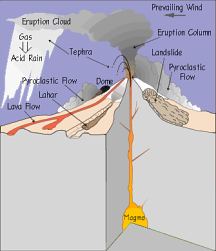
stratovolcano features usgsVolcanic eruption basics

Eruptions can be effusive with flowing rivers of lava or (gentle) or explosive with rapidly occuring eruptions which generate large volumes of ash. Fluid lava eruptions tend to be more effusive with some lava fountains and are generaly found in hot spot or rifting settings. The rock type erupted here is normally basalt which is sourced from the mantle. Occasionally basalt will be erupted in subduction zone settings ie. Stromboli and Etna. In this situation the magma will have ben injected into the base of the volcanic system from the mantle and had little chance to pond in a magma chammber before erupting. Lava fountains can occur.

Explosive eruptions tend to occur at subduction zones where lava is more viscous and contains more gas and steam. As magma rises within the crust its chemical composoition changes. Silica is added from the surrounding crust which makes it more viscous, water and gas form bubbles .Within the magma chamber the melt cools and starts to crystallise making it less fluid. All this stickiness makes for an explosive mix-bit like blowing bubbles in thick milk shake! Exceptions are where hotspots occur under continental crust which cause giant caldera forming volcanoes or supervolcanoes. Supervolcanoes put other eruptions in the shade. They erupt incredibly violently for days on end and change the climate of the whole world by filling the atmosphere with ash and dust. We don't want one to go off.

Hawaain lava flow USGS

Hawaiian

Hawaiian eruptions are characterised by the long flowing rivers of basaltic lava which gradully build up into vast shield volcanoes. Lava fountains, fissure eruptions and lava flows are the main characteristics. eruptions are effussive rather than explosive and are generally much much safer.

Basalt can form two distinctive lava flows one called "pahoehoe" in Hawaiian or rope like and "aa aa" which popular myth says is the sound you make if you walk on it bare foot-its very sharp.

Pahoehoe is very fluid and flows like custard or treacle, it can form channels which then roof over to form lava tubes. Aa aa is a slower moving flow with a steep front and is blocky and jagged.

Strombolian

Strombolian eruption USGS

Strombolian eruptions are characterized by the intermittent explosion or fountaining of basaltic lava from a single vent or crater. Each episode is caused by the release of volcanic gases, and they typically occur every few minutes or so, sometimes rhythmically and sometimes irregularly. The lava fragments generally consist of partially molten volcanic bombs that become rounded as they fly through the air.
Stromboli in the aeolain islands of Italy is on eof the worlds most reliable and cintinually active volcanoes- worth the walk!

Surtseyan/Pheatic

Sertsey eruption IcelandPhreatic eruptions are steam-driven explosions that occur when water beneath the ground or on the surface is heated by magma, lava, hot rocks, or new volcanic deposits (for example, tephra and pyroclastic-flow deposits). The intense heat of such material (as high as 1,170° C for basaltic lava) may cause water to boil and flash to steam, thereby generating an explosion of steam, water, ash, blocks, and bombs.

Surtesy erupted off the coast of Iceland between 1963 and 1967.

Mt.Pelee eruption on MartiniquePelean

The pelean style of eruption is charcterised by fast moving pyroclastic flows or surges whcih incinerate everything i their path. Large volumes of dust,ash.rock and gas are ejected from the volcano then career down slopes as Nuee Ardente or pyroclastic flows.
The style is named after Mt.Pelee in the Carribbean which erupted in 1902 killing 28 000 people.

Vulcanian

Vulcano crater LKPVulcanian eruptions are noisy and dramatic and are named after Vulcano in the Aeolian Islands. A phreatomagmatic
(steam and lava) eruption occurs first, then a black explosive cloud as the volcano vent is cleared then a final whiter column of ash and gas. Lava bombs are not rounded and are typically made of viscous andesite and dacite which could explain their ragged shapes. A final viscous lava effusion may occur. Stromboli and Soufriere Hills have both shown this eruption style.

Plinian and Ultraplinian

Pintatubo ash columnPlinian eruptions are named after Pliny the Younger who wrote a detailed accoount of the eruption of Vesuvius in AD79. He likened the tall eruption cloud to an umbrella pine- tall slender trunk and large spreading top.
Eruption clouds can extend well above 11km into the atmosphere and produce vast quantities of ash and gas.When the column looses its upward momentum it collapses back down the slopes of the volcano creating pyroclastic flows. Ash and pumice fall may be deep enough to bury homes,collapse roofs and turn day to night. Lahars may form where ash and water mix burying everything in their path.

Pompeii and Hercalaneum were famously buried in AD79 and the last eruption of Vesuvius was in 1944.

Mt. Pinatubo, in the Phillipines,was the worlds last dramatic plinian erption in 1991. Due to the proximity of an american airbase the voclano wa closely monitored and 1000s of locals evacuated to safety. Although the lahars and refugee camps caused many fatalities.

Volcano videos