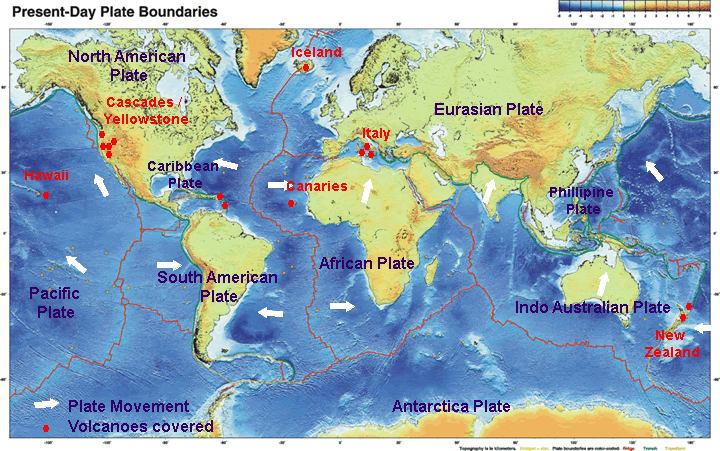
Mt Etna:Sicily Mt Etna is not only Europes tallest volcano (3326m) but one of the two most active. It measures 140km around its base and its lava fields dominate Eastern Sicily. It has been erupting for 500,000 years. The Geology Bit Etna lies near the subduction zone boundary of two tectonic plates( European and African) This type of boundary would usually cause explosive and violent ash cloud eruptions like Vesuvius and the Aeolian Islands. However, unlike the neighbouring Aeolain Islands the activity is more like Hawaii, with basaltic lava flows and fountains. So its origins remain a geological puzzle but the lava certainly comes from a direct route from the mantle probably due to extension on the overlying plate rather than the accepted magma generation process caused by a subduction zone. The basalt which is erupted in spectacular fountains and lava flows is certainly not typical of a subduction zone. Etna started forming 500,000 years ago on the floor of the mediterranean sea and emerged from the sea, with Sicily, around 100,000 years ago. The summit area has 3 craters , The central crater ( encompasses La Voragine/Chasm and Bocca Nuove), the NE Crater and the SE Crater. The SE crater has produced the most spectacular eruptions or paroxysms of in the last 10 years. There are numerous parasitic cones and vents over Etnas slopes and eruptions are not exclusively from the crater area. On the eastern side of Etna is the Valle de bove a 5km wide valley or scoop down which many of Etnas summit lava flows tavel. The main rock type erupted is basalt a molten rock sourced from the earths mantle which has a temperature of around 800 C when molten. It forms two types of lava flow "aa aa" slow moving and very rough and "pahoehoe" or ropey lava which moves in smoother manner. Etna can also produce fire fountains of lava 100s of metres high and large quantites of tephra and bombs. The population of Eastern Sicily have a love hate relationship with their volcano. Etna provides wonderfully fertile soils for olives and grapes and slopes for skiing but it also threatens their homes with lava flows. 1669:The Nicolosi and Monte Rossi vents produced lava flows which threatened Catania and the first attempts at lava diversion were made . 1983: Sapienza threatened and attempts at lava diversion with explosives were made. Etna has not had rest from erupting and throughout the 90s and into the 00s.For more eruption detail please use the link below. Buy guides to Sicily at our Online Shop Detail on eruptions : Boris website What to see and How to see it? Etna was made a national park in 1987 : "Parco dell'Etna" The snow has largely gone from Etnas upper slopes between May and September although you will find patches. Access to Etna is usually from the south side to the top cable car station at Piccolo rifugio. Below the Rifugio Sapienza is located at 1910m and has shops and restaurants; it is the base of the cable car and easily reached by a paved road. 4WD tours often leave from the top cable car staion so check with the local tourist office or at the Rifugio Sapienza. Ascent to the summit from the north side can be arranged in Lingualossa, check the tourist office for guides and trips. 4WD trips leave from Piano Provenzana, which is recovering from the 2003 eruption and go to Piano delle Concazze, at about 2700 m. All trips to the summit are subject to change or cancellation due to activity . To try to go without an experienced guide would be daft to say the least. The following companies provide tours and trips with experienced guides not just to the summit but to other features of interest such as lava tubes and hornitos! www.volcanodiscovery.com www.etnatrekking.com www.volcanotrek.com Etnas terrain is rough under foot and sharp. A good pair of boots and gaitors area good idea as is a walking pole. Lava is sharp to sit on and can cut your legs so trousers for most of us and shorts for the most hardy .The summit area is high so be prepared to go a little slower due to altitude and pace yourself. Buy equipment and guides at our Online Shop Etna Links : www.vulcanoetna.it : Etna webcams www.volcanodiscovery.com: Activity updates Global Volcanism project www.Volcanoetna.com Italy Cradle of Vulcanology Stromboli Online:Etna www.Decadevolcano.net To the top / Uk shop / USA shop |
![]() ![]() ![]() ![]() |
Stromboli:Aeolian Island The island of Stromboli is the top of volcano which emerges from the Tyrrhenian Sea and is part of the Aeolian islands off the North East coast of Sicily. The cone rises 924m above sea level and the volcano has been continuously erupting for at least the last 2000 years. The Geology Bit Stromboli forms part of Calabrian Island Arc. The Tectonic setting of the Mediterranean can be complicated but essentially the volcanic activity here is caused by the westwards subduction of the African plate beneath the European plate containing Sicily and the Tyrrhenian sea. This type of setting typically produces explosive and violent eruptions like those of Vesuvius but Stromboli seems to have a continuously open vent which allows frequent eruption of lava bombs and incandescent lava fragments every few minutes of hours. This style of eruption is called Strombolian. To the top / Uk shop / USA shop What to see and How to see it? The best way to climb Stromboli is with a guide. At 924m this is around 3000ft to the top. The most popular way to ascend the volcano is in late afternoon so that the summit fireworks can be seen after dark. Descending the mountain in darkness without a guide is not recomended and would be decidedly hairy. The tourist office will help you find a suitable guide and one that is sanctioned by the Club Alpino Italiano Office on the island. Stromboli can be reached by ferry from the Sicilian mainland and other Aeolian islands. There are no cars on the island, but golf carts and mopeds! The summit most people climb to is the Pizzo sopra la Fossa at 918m. The path follows the waterfront past Ficogrande and then turns upwards to the observatory at Punta Labronzo. It is then worn and sunken zig zag path upwards to a rock refuge before a final ridge walk to the top. The Sciara del Fuoco is on your right, and is a steep slope down which many of Strombolis bombs and lava fall.The ridge walk may be done after dark so a headtorch is absolutley essential. The whole walk to the top ,at a steady pace, takes 4 hours or so. If its dark you will not be able to see the detail of the circular depression at the top. The active vents are 100-150m below the walking summit and you probably heard and smelt them on the way up. There are currently three craters which regularly eject lava into the air up to 300m but more commonly 100m. Stromboli can behave erratically and lingering at the summit for too long may put you at risk from bombs. The descent can be the ascent route or down the "moonwalk" path which is a long descent down an ash slope líke walking down a giant sanddune. The path then becomes sunken and vegetated before emerging onto a track and finally Stromboli town. The whole ropund trip can take 6-7 hours depending on conditions so is not suitable for young children. Adequate warm clothing , food and drink is a must for this trip as it can be cold at the top and at rest stops. Walking poles, gaitors, headtorch and facemask are strongly reccomended. A hardhat should be provided by the guide and possibly a facemask. New Ascent regulations from August 2007 Buy equipment and guides at our Online Shop www.volcanodiscovery.com www.etnatrekking.com www.volcanotrek.com Stromboli Links Global volcanism project Stromboli Online:Stromboli Volcanoworld.Stromboli To the top / Uk shop / USA shop |
![]() ![]() ![]() ![]() ![]() |
Vulcano:Aeolian Islands The island of Vulcano has a "pocket sized" volcano which does not require the strenuous long hikes of Etna and Stromboli to see. The highest point on the island is 499m. The Geology Bit Like Stromboli, and its Aeolian neighbours, Vulcano is part of the Calabrian Island Arc and has typically infrequent violent eruptions the last one was in 1890 from the Fossa cone. There are 3 main volcanic centres ;at the southern end of the island Monte Aria,Monte Saraceno and Monte Luccia;Gran Cratere (Fossa Cone) which sits within Lentia caldera; Vulcanello originally a separate islet which appeared in 183BC whcih was connected to Vulcano in 1550 by a pyroclastic flow. The last eruptions of 1890 devasted the island and 5m of pyroclastic material was deposited near the summit. The numerous fumeroles on the summit are closely monitored for any new activity brewing. What to see and How to see it? The climb to the top and crater circuit of the Fossa cone (391m) is the main highlight of Vulcano and is easily accessible to those who are reasonably fit and prepared, and takes a morning or afternoon.It is not a particularly strenuous climb but a bit rocky and ash covered. The hydrofoil and ferry stop here and small boats can bring you from Lipari. The path heads up from Porto di Levante , past a warning sign about the hazards of the volcano! Once at the top a view of the 460m wide crater opens up. The crater is 175m deep and some rock art is visible on the crater floor. Climbing down into the crater is not advised firstly because of poisonous gases that accumulate here and secondly its a long way back up over rough and hot ground. The crater rim steams with fumaroles and sulphurous fumes and the smell of sulphur and rotten eggs is on the damp hot breeze. Careful where you sit and put your feet as the ground and fumes can be very hot - scalding! An ash covered slope descends once you have circumnavigated the crater rim . Its like walking on a giant sand dune. Vulcano also has a geothermal open air mud bath with supposed health giving properties and the sea has warm water springs when you want to freshen up. Remove any metal jewellery as it will get spoilt. A stick,gaitors an old swimming costume and towel may came in handy. Buy equipment and guides at our Online Shop Vulcano Links Volcanoworld: Vulcano Stromboli online:Vulcano www.volcanodiscovery.com www.etnatrekking.com www.volcanotrek.com To the top / Uk shop / USA shop |
![]() ![]() ![]() |
Vesuvius At 1281m high Vesuvius looms over the 3 million inhabitants of Naples on the Italian mainland. it is probably the most famous volcano in the world owing to its devastating eruption in AD79 which buried the Roman cities of Herculaneum and Pompeii. Vesuvius has been active for 25,000 years and last erupted in 1944. The Geology Bit Vesuvius is a stratovolcano composed of layers of ash and lava.The main cone Gran Cono (1281m)was formed in the AD79 eruption and sits within a caldera caused by the collapse of a larger cone called Monte Somme (1149m).Vesuvius owes its existence to the subduction of the African plate below the European plate along a convergent or destructive boundary. Vesuvius erupts in a Plinian style. In Ad 79 Pliny the Younger documented the eruption , which described a vertical column of smoke which spread out like an umbrella higher in the atmosphere. As the eruption looses its upward power the column and cloud collapse depositing large volumes of pumice and scoria. Pyroclastic clouds plunge down the volcanoes sides consuming everything in their path. It is the pyroclastic flows which eventually finished off the remaining inhabitants of Pompeii. Pliny the elder was a naval commander killed by the eruption whilst attempting to rescue people and observe the volcano. In 1944 Vesuvius erupted again and pumped ash clouds into the sky. The town of San Sebastiano had already been destroyed by lava in 1822,1855 and 1872 and now faced the lava again. A ten foot high wall of lava invaded the town and destroyed buildings yet again. To the top / Uk shop / USA shop What to see and How to see it? The car park at 1000m is the place to start your circuit of Vesuvius s crater. There is a 1.5km long track to the crater rim from here for which you will have to pay a fee. It is a steep track which should take around 30 minutes to an hour.The crater rim walk may be closed in bad weather. The crater walk round the AD79 crater is spectacular as you look down into the chasm over 300m deep. If you wish to descend to the crater floor contact the Club Alpino Italiano who may arrange a suitable guide. Lavas from the 1944 eruption partially cover the crater floor and you may see fumaroles. The car park has snack bars and mineral stores which sell minerals from nowhere near Vesuvius! There is a paved road to a car park at 1000m . The train also links Ercolano with Pompeii. Buses leave from Pompeii Tourist information for around 10 Euros and more unreliably from Ercolano. Buy equipment and guides at our Online Shop Pompeii Pompeii was a prosperous Roman City complete with Amphitheatre and Forum. It was a popular destination for Romans on holiday. It has been extensively excavated from its covering of volcanic ash and pumice and is fantastic to wander around. Walk into houses that feel like the owners have just popped out of and see original paintings and frescos on the walls. Wander past fast food stalls Roman style and cross over chariot rutted roads.There are even political slogans written on walls in Latin and a brothel. Some of the population no doubt fled at the first rumblings from Vesuvius but others reamined as the ash and debris rained down on them blocking streets and doorways. It was eventually overwhelmed by at least 6 Pyroclastic flows or surges which are hot avalanches of gas,ash and rocks which move at incredible speed. Nothing survives a pyroclastic flow and many citizens were entombed in their dieing positions as they were overcome by the flows. Plaster has been poured into the moulds left by the bodies and can be seen Antiquarium near Porta Marina. Other Highlights Villa dei Misteri Casa del Fauno Casa dei Vetti Museo Vesuviano Via dell'Abbondanza Gladiator School Getting to Pompeii Take the private train line Circumvesuviana that runs between Naples and Sorrento. Get off at Pompei Scavi. If you take the Naples to Poggiomarino get off at Pompeii Santuario. SITA bus runs from Naples to Salerno stops at Pompei in the piazza Esedra. Pompeii exit from Autostrada A3. Admission Single ticket €10. Three day pass to access five sites: Herculaneum, Pompeii, Oplontis, Stabiae, Boscoreale for €18. Opening Times November - March: every day from 8.30 a.m. to 5 p.m. (last admission 3.30 p.m.) April - October: every day from 8.30 a.m. to 7.30 p.m. (last admission 6 p.m.) Closed: 1st January, 1st May, 25th December You can leave luggage and backpacks at the Left Luggage departments at Porta Marina and Piazza Anfiteatro. Official Pompeii site Buy equipment and guides at our Online Shop To the top / Uk shop / USA shop Hercalanuem Hercalaneum is Pompeiis lesser known neighbour but is just as fascinating. Hercalaneum was a seaside port on the southern slopes on Vesuvius. It was overwhelmed by a series of Pyroclastic flows just like Pompeii. In arched chambers by the shore near the Suburban Thermae (Town Baths) hundreds of skeletons were found fruitlessly sheltering from the pyroclastic flows. Charred door frames from the orginal buildings and mosaics survive intact. There is a rarely preserved intact Roman theatre which can seat 3000. A seat of learning carbonised scrolls have been recovered and read. Hercalaneum is within the not too pretty modern town of Ercalano. It is reachable by train on the Naples to Sorrento line and vice versa where a walk down the hill and through the town will bring you to the site. An entrance fee is payable. Vesuvius Links Global Volcanism project VulcanoEtna.com Vesuvius www.Roman-empire.net:Hercalaneum BBC History: Pompeii Wikipedea:Pompeii www.vesuvioinrete.it: Gateway to Vesuvius Official Pompeii site To the top / Uk shop / USA shop |
![]() ![]() ![]() ![]() |
Santorini (Thera) Santorini lies in the Southern Aegean sea and is considered one of the most dramatic and beautiful Greek islands. The crescent shaped island wraps around a lagoon 12km long by 7km wide and is surrounded by 300m high cliffs which extend a further 400m under water. It is the most active volcano in Greece. The Geology Bit Santorini lies within the Southern Aegean Island Arc and owes its existence to the subduction of the African plate beneath the European plate along the ionian trench to the south of Crete. In 1650BC a catastrophic Plinian ( like Vesuvius)eruption blew the centre out of the island creating an eruption column estimated to have been 23 miles high. The explosion is thought to have caused a tsunami which devastated the northern shore of Crete to the south and precipitated the decline of the Minoan civilisation. The sea flooded into the caldera created by the evacuation of the magma chamber , hence the steep cliffs which extend below the waterline. Unlike Pompeii it would appear that the population were able to evacuate before the final eruption as no human remains have been found in the ancient city of Akroteri. Hundreds of feet of ash were deposited by the explosion.There have been 11 eruptions since 197 BC the most recent being on Nea Kameni island in 1950. Most of the lavas are dacitic which means they are quite viscous and form domes and short lava flows. To the top / Uk shop / USA shop What to see and How to see it? Nea Kameni Boats depart from the port of Athinios and land at Kato Fira (Yialo) on Nea Kameni . A path from here goes across lava from 1925 before going up to the ashy slopes of Mikri Kameni . The path continues towards and around the main Dafni crater. Next onto 2 craters formed in 1940 which are steaming with fumaroles and bright yellow sulphur and up to the summit of the island at 127m. look out for breadcrust bombs along the way with their distinctive cracked crust. About 4 hours on the island should be enough to fully explore all the lava fields and have a good look round. On the way back stop off at Palea Kameni to bathe in hot spring heated bay of Agios Nikolaos. You can climb to the 98m summit for a good view of the Santorini caldera and Nea Kameni. There is a cross section through a lava dome on the SE shore best viewed from the boat. Akrotiri Excavations began in 1967 of the former Minoan city buried by the 1650BC eruption. You can get a visitors guide at the entrance to the site. Not much has been excavated yet but it is interesting to see how earthquake damage was repaired before the eruption took place. The ancient city was engulfed by pyroclastic flows. Quarries The thick deposits left by the eruption can be seen in two quarries one to the south of Fira and the other on the Akrotiri road. Layer upon layer of pumice and pyroclastic flow deposits in cliffs up to 20m high. You can even see the orignial soil layer from before the eruption. Buy equipment and guides at our Online Shop Santorini Links Global Volcanism project Stromboli Online:Santorini Santorini.net Decade volcano:Santorini Wikipedea : Santorini To the top / Uk shop / USA shop |
![]() ![]() ![]() |
Iceland |
![]() Arni Einarsson, Myvatn Research Station ![]() ![]() ![]() ![]() ![]() ![]() ![]() ![]() ![]() ![]() ![]() ![]() |
Tenerife Tenerife lies within the The Canaries islands 70 miles off the west coast of Africa in the Atlantic Ocean. Teide is the highest mountain in Spain at 3715m but stands 7000m above the sea bed. Teide is the third largest volcano on the planet by volume. The Geology bit Mt. Teide is a stratovolcano topped by the Las Canadas caldera. The caldera is 7-12 miles (12-20 km) and partially filled by various vents. The volcanoes started to from 150-180ma years ago when the Atlantic Ocean formed.However their origin is up for discussion. They lie away from an active plate boundary so it is thought that an intermittant supply of lava comes from a hot spot or mantle plume. Extension in the crust may let the magma rise to the surface but supply may cease if extension happening. This may account for the longer periods of inactivity. Teide last erupted in 1909 and is a shield volcano with a high level caldera. The volcanics are simalr to those of hawaii with basaltic lavas dominating. What to see and How to see it? Teide is a volcano accessible to most and a cable car runs from the roadside at 2366m to near the top at 3555m . Access to the summit is restricted but a free permit is available from the Park office in Santa Cruz allowing you to climb the last 200m. Car to the bottom of the cable car is most people choice just be aware of the sudden change in altitude could make some feel light headed. It will be chilly and windy at the top and you will be above the clouds. A Bus also runs from Peuerto Cruz and Playa de las Americas. Numerous bus tour companies will take you out on a day trip from your local resort. Buy equipment and guides at our Online Shop Tenerife Links Volcanoworld Stromboli online : Tenerife To the top / Uk shop / USA shop |
![]() ![]() |
Lanzarote Lanzarote like Tenerife owes its landscape entirely to volcanic activity. Unlike Tenerife there is no monumental peak such as Teide but there is the spectacular Timanfaya National Park. Timanfaya National Park is home to Lanzarotes most recent volcanic landscapes. In September 1730 a fissure eruption started which was to last for 6 years and bury 11 villages. 200 sq km of land was covered and the lava poured into the sea along 20km of coastline. The Geology Bit Lanzarote like Tenerife owes its landscape entirely to volcanic activity. Unlike Tenerife there is no monumental peak such as Teide but there is the spectacular Timanfaya National Park. The volcanoes started to from 150-180ma years ago when the Atlantic Ocean formed.However their origin is up for discussion. They lie away from an active plate boundary so it is thought that an intermittant supply of lava comes from a hot spot or mantle plume. Extension in the crust may let the magma rise to the surface but supply may cease if extension happening. This may account for the longer periods of inactivity. To the top / Uk shop / USA shop What to see and How to see it? The Montanas del Fuego complex within the National park is where most people head to to experience Timanfaya. You pay an admission fee a the park entrance which covers the guided bus tour.A paved road leads across lava fields to a sloping car park. From here you can take the bus tour with commentary in English, German and Spanish around the volcanic landscape 9.00-5.45 everyday last tour 5pm. You can't drive round yourself or get out and walk about so this is pretty much the only way to see the landscape. Two "hot holes" in the ground near the restaurant show how hot the ground here is by setting fire to branches and erupting steam. The restuarant cooks meat on the naturally hot rocks and provides a fantastic panorama of the park. Off course being Lanzarote it will be windy outside! Timanfayas visitor centre is on the northern limit of the park on the road to Mancha Blanca . Its pretty good on the geology and volcanoes plus it has sections on wildlife. Toilets here. Buy equipment and guides at our Online Shop Lanzarote Links Global Volcanism project Discover Lanzarote.com To the top / Uk shop / USA shop |
![]() ![]() ![]() |
| Home |
|---|
| Webcams |
| Shop |
| Contact us |
| Featured Volcanoes |
If you like the site why not link to us
Need help with this just contact us.
Volcanic Information |
|
| Travel | All About Volcanoes |
| Volcanic trips, tours and treks | Types of volcano |
| What to take | Picture Glossary |
| Travelogues | Plate Tectonics |
| Contact us | News/Activity Updates |
![]() |
![]() |
![]() |
![]() |
|
Hawaii |
Yellowstone Supervolcano | Mt .Etna Europes largest volcano |
Mt.St.Helens Washington USA |
Stromboli Lighthouse of The Med. |