Advnture Travel Hut: Your Gateway to Adventure
Adventure travel hut
Worldwide adventure gateway, + gear,books and destination profiles

Montserrrat: Soufriere Hills
Now she puffs but will she blow?
Trust the Lord and pray its no.


Montserrat is a small tear drop shaped volcanic island in the Carribbean . The Island is one of the last remaining outposts of the British Empire and before 1995 was called the Emerald Isle. This Irish sounding name came from the lush green tropical vegetation and from the Irish settlers who inhabited the Island from 1632. Previously to 1995 Montserrats greatest claims to fame were the recording studios which saw music groups such as The Police record here. The video to"Everything little thing she does is magic" was fimed here.

The Geology Bit
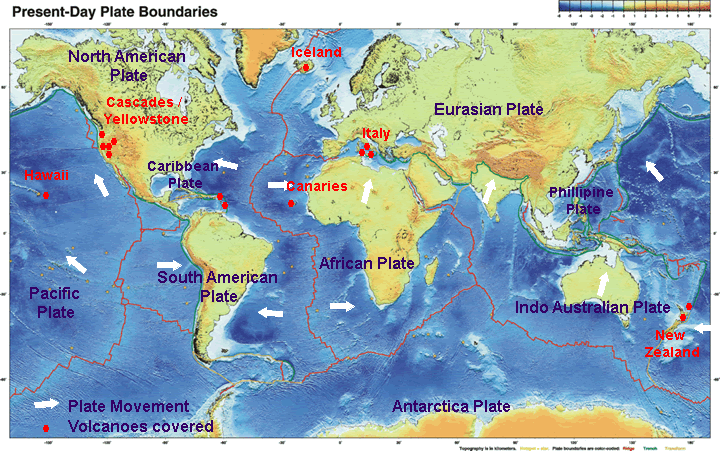
Montserrats active volcano is the Soufriere Hills Volcano topped by Chances peak at 915m (3000ft) and is around 25000 years old . Montserrat owes its existence to volcanic acivity and is part of the Antilles Island Arc. Formed due to the subduction of oceanic crust of the North American Plate beneath the Caribbean Plate in a WSW direction at a rate of 2.2cm/year. As the oceanic plate descends magma is generated whcih gradually works its way to the surface and eventually erupts as a volcano.

Andesite,basalt and dacite are the found on the island which indicates that fractional crystallistion has probably occured within a magma chamber to produce the more silica rich melts such as dacite from more Fe rich magma.

The Soufriere Hills volcano is a stratovolcano and exudes a very sticky lava called dacite .English's crater on the summit of Chances Peak has been the site of the recent activity since 1995. The crater is 1km wide with walls up to 150m high. The eastern side opens down the Tar river river valley which funnels pyroclastic flows to the sea. Since 1995 a dacitic dome has sat within the crater and regularly produced pyroclastic flows and ash clouds.

Instead of rivers of flowing lava "Hollywood style" the dacite forms a plug or dome of lava which pushes up vertically like very sticky toothpaste. As the lava pushes upwards it becomes unstable and collapses. This leads to a volcanic hazard called a pyroclastic flow. This is a hot avalanche of hot rock,ash,lava and gas which surges down the slopes of the volcano in a billowing grey cloud. The cloud can move at 100mph and you don't stand much of a chance if you are in the way. Most of the gas had escaped from the magma but some remained which caused explosions and eruption clouds of ash up to 40 000 feet.

Montserrat Volcanic Observatory MVO
Montserrat Volcanic Observatory MVO: Photo Archive
USGS: Montserrat Pyroclastic flows effects
BGS: British Geological Survey : Montserrat

To the top / Uk shop / USA shop

Eruption Calendar
1995
July :FirstPhreatic eruption ( steam and ash )
December : Plymouth evacuated


1996
March-September : Pyroclastic flows create new delta of land as they enter the sea from the Tar river valley. Notably on Mothers day!
April : Plymouth abandoned


September: First vertical explosion up to 9miles high ejected bombs 1 metre across . Some debris landed over a mile away away.

1997
May : Pyroclastic flows flow over the northern crater wall for the first time
June 25: 19 people killed in a pyroclastic flow as they returned to tend their crops in the exlusion zone.

August : Pyroclastic flows destroy Plymouth the capital

September : Bramble Airport destroyed by pyroclastic flows. Exclusion zone now covers two thirds of the isalnd. Safest area is in the north where 5000 people are living as refugees in their own country.

October : Dome has grown 250ft above the crater rim and is growing at 280 cubic feet/second

December : Boxing Day eruption: The Dome could no longer support itself and a giant landslide clattered down the White river valley releasing the pressure on the magma below and causing the largest explosion yet. Four sq miles of the island was devasted in 15 minutes. An eruption cloud rose to 36,000feet.

1998
January : Only 4000 of the original 11 000 population remain having left for Antigua or the UK.Montserrat more dependent on aid than any other country.
July : Dome collapses and eruption clouds rises to 35,000 feet.
September : Hurricane George deluges the island with rain causing floods. The rain mixs with ash to form mudflows or Lahars which bury the landscape further.

2000
March: Dome collapse causes pyroclastic flow and a large explosion shoots re hot llava fragmenrs hundreds of metres into the air.
Montserrat Volcanic Observatory MVO

To the top / Uk shop / USA shop

What to see and How to see it?

If you have just read the section above you might think Montsserat was a barren no mans land. It is true to say that the a large portion of the southern part of the island has been covered in ash but the northern part is still very much a beautiful and lush landscape. The Island is only small ( 7 miles North/South and 3-4 East/West at its widest) so you are never far from the volcano. Much of the Island lies within an exclusion zone that was implemented to protect the islanders from the volcano. To the north of this the island is bieng rebuilt and Montserrat is open for business.

Getting There
Montserrats new airport was opened in 2005 and recieves flights from Antigua . Antigua recieves flights from long hau destinations.
Fly Winair.com Flight information

There is essentially one main road which follows the outside of the island and then has offshoots. You will need a local drivers licence which you can apply for at the airport or a police station ( Salem and Brades ) for £10 or $19. There are only 2 petrol stations. You can always hire a bike if you're feeling fit! Or take a taxi if you're not!

Banks/Shops Climate/Water/ etc.etc.


VisitMontserrat.com : Official Montserrat Tourist board site


Boat trip: Visiting the exclusion zone is not an option for a tourist but you can view the southern half of the island by boat.Trips leave from Little Bay and take in Plymouth,Tar River Valley and the remains of Bramble Airport. You can view the paths the pyroclastic flows took, see how Plymouth has been gradually buried by Lahars and see the new delta at the base of the Tar river valley. Each tour lasts around 2.5 hours.
The Green Monkey Inn and Dive Shop: Diving and Boat Tours

Land based viewing is only within the safe zone.
View Plymouth from Richmond Hill.
Soufriere Hills and Bramble Airport from Jack Boy Hill in the North East of the Island where there is a telescope and picnic area.
Helicopter trips are available from Antigua to view the volcano but not land.

Caribbean Helicopter Tours

Montserrat Volcanic Observatory: The MVO is in Flemmings and is open Monday to Friday and provides displays and information about the volcano. On Tuesdays and Thursdays at 2pm you can meet a geologist from the observatory for a tour of the monitoring station.

Day Trips from Antiguas can be arranged as can Volcano Tours on the Island. The Montserrat Tourist Board site provides contatc information.

Links
VisitMontserrat.com : Official Montserrat Tourist board site

Global volcanism project

To the top / Uk shop / USA shop


Montserrat : pyroclastic flow delta / USGS

Effects of pyroclastic flows in Plymouth

Ptroclastic flow skirting a house / USGS

Plymouth destroyed by pyroclastic flows / USGS RP Hoblitt

NASA photograph of Montserrat

Soufriere Hills volcano erupting US Govt source

A quieter Soufriere Hills


Martinique:Mt Pelee
Mont Pelee(1379m / 4583 ft)lies on the Northern tip of the Lesser Antilles island of Martinique and is considered the most regularly active volcano in the Caribbean. Pelee means bald in French and this probably refers to the denuded volcanic landscape the first French settlers saw in 1635. Martinique is one of the remaining outposts of France in the world and you can have proper croissants that taste as good as the one in France after a dip in the Caribbean.

The volcano was last active 1930. In 1902 a catastrophic eruption destroyed the beautiful town of St.Pierre killing 30 000 people.


The Geology Bit
Martinique owes its existence to volcanic acivity and is part of the Antilles Island Arc. Formed due to the subduction of oceanic crust of the North American Plate beneath the Caribbean Plate in a WSW direction at a rate of 2.2cm/year. As the oceanic plate descends magma is generated which gradually works its way to the surface ans ecentually erupts as a volcano.
The oldest rocks on the island are 24 million years old and there are 8 volcanic centres. The Chemistry of the erupted rocks implies that the magmas for each centre came from different sources. The oldest lavas are andesitic lavas with a strong influence from tholeiitic magma which is high in Iron and Magnesian (tholeiitic melts are the same source and compostion as basalt lavas, same as oceanic crust). Around 16 million years ago melts became more calc-alkaline and richer in silica with more andesite erupted. This second phase is more typical of a mature volcanc arc.

Mt. Pelee is a 400,000 year old stratovolcano and was formed mostly by violent explosive eruptions. The Nuee Ardentes of pyroclastic flows have been caused by dome collapse ( as on Montserrat) and eruption column collapse , where the upward eruption of material in a cloud cannot be maintained and the material collapses back to earth. Both types produce Nuee Ardentes or pyroclastic flows and the associated pumice ignimbrite deposits of ash and ejecta. The 1902 eruption was probably a lateral blast which contained little material but was composed of superheated steam,gas and some ash. Over the last 5000 years the volcano has alternated between Nuee Ardente and Plinian eruptions around every 750 years.


To the top / Uk shop / USA shop

USGS: Mt.Pelee
How volcanoes work: Mt.Pelee

The 1902 eruption
On May 8 1902 Mt.Pelee unleashed an eruption which killed 30 00 people. Probably the highest volcanic death toll in modern times. Volcanology was in its infancy in the 1800s and the previous stirrings of the volcano in 1792,1851 and 1889 were considered nothing to be concerned about. In February 1902 sulphurous gases killed birds and in April earthquakes shook the mountain and the first eruption cloud covered residents in ash.

If this had happened in modern times then evacuation and close monitoring would have been organised but in 1902 the Martinique government had more pressing matters to attend to. The elections to decide who controlled the island. The ruling Progressive party wanted to maintain white control of the island and were being rivalled by a black candidate from the Radical party. In St.Pierre a the Progressive Party had won but not by a clear enough majority so another vote had to be organised for May 11.

On May 2 the volcano rumbled and showered the countryside with ash a glow was seen at the summit. People came to St.Pierre to escape the worst of the ash. A Martinique newspaper assured residents that there was no real danger and even organised a boat excursion to see the volcano on May 4.

On May 3 and 4 people watched the fireworks from the volcano. Food and fresh water were running low but the residents stayed on because of the election and reassurances that all was well! A mudflow engulfed a sugar mill and killed 23 people . When it entered the sea it caused a Tsunami which inundated the water front area killing 68 people. Soldiers were now brought in to prevent people leaving the city! The local population turned to Voodoo rituals for help.

On wednesay the 7th Nuee Ardent clouds flowed down the mountain but injured no one as the villages were by now empty. The Italian ship Orsalina was due to sail on the 8 but here captain sailed a day early leaving his passengers behind.

On the Morning of May 8 at 7.50am, as people were going to the Ascension Day services, a black cloud raced down the volcano at an estimated speed of 600km/hour and engulfed St.Pierre. A giant eruption cloud covered the sky for a 50 mile radius. The Governor ,his wife , The American consul ,his wife and the British consul were all killed as were 29 000 other residents.

The city was probably destroyed by a thin and rapidly moving Pyroclastic surge which came out laterally from the volcano. Only a few cms of ash was deposited so it seems the surge was probably only part of the explosion and the part of the eruption Nuee Ardente did not reach the town,as more rocks and a thicker deposit would have been left.(similar to Mt.St.Helens). The blast was composed of gas,steam and dust and was probably around 1000 C .

The city burnt for several days afterwards. 18 ships with crew and passengers in the harbour were also destroyed. Only 2 people survived on land a shoemaker and a prisoner in a small cell - Cyparis. A British ship managed to limp to St.Lucia with a badly burnt crew.

The volcano carried on erupting violently until the end of August taking another 1000 lives in villages. A tall Spine of lava was extruded from the summit reaching 340m in 1903.

Thankfully modern science can hopefully avoid such disasters happening again. The eruption lent its name to a pelean type of eruption which involves a lateral superheated blast. Not until MtSt.Helens would one be closely studied again.


To the top / Uk shop / USA shop

What to See and How to see it?

First thing to realise is that Martinique is essentially piece of France transplanted into the Caribbean - so some French language phrases will go down well as English is not widely spoken( even if people speak it!) Secondly its a hot and steamy place with a hurricane season through Summer and Autumn. Martinique is a department of France so has the Euro as its currency.

Martinique.org:Official Tourism site

Getting To Martinique
There are International flights from the US.Delta flies from Atlanta. American Airlines ans Air France from Miami . Catamarans run from Guadalope,St.Lucia and Dominca. Car Hire is available from the airport - just remember to drive on the right!
St.Pierre
St.Pierre is a pretty 45-1hour drive along the N2 coastal road from Fort-de France. You can also take a more inland and windy route through the Pitons de Carbet National Park.
St.Pierre has been reconstructed since the eruption and lies just 4 miles away from Mt.Pelee.

You can see remains of the old buildings throughout the town. Notable ruins to see are the old theatre whcih seated 800 people and the cell of Cyparis one of the only survivors of the eruption.The collapsed Church of the Fort was where the Ascension Day service was takng place and where all the congregation perished. You can also dive on the wrecks in the harbour. Notably the Roramia which was set on fire and sunk by the explosion.

The Observatoire Volcanoloique de la Montagne Pelee monitirs the volcano with a netwok of seismometers and but is unfortunately not open to the public.

The Musee Vulcanologique is worth a visit to see artifacts from the eruption.


Ascent of Mt.Pelee
The most popular route starts from a car park at 830m ( 2700ft) near the village of Le Precheur on the western slopes of the volcano on the D39 or" Route de L'Aileron" and should take 3-5 hours to ascend and descend. The path is well maintained and climbs over old deposits,domes and andesie flows to the summit crater. The 1902 and 1929 domes sit within the crtaer and are largely composed of andesite blocks.The domes are already covered in vegetation. The summit is the top of the 1929 dome. The top of Mt.Pelee shows little activity and there is a distinct lack of steam or sulphur.
Climbing a mountain in the tropics can be hot steamy work so take plenty of water and try to walk in the cooler morning. The summit may be shrouded in cloud at any time of day but more likely the afternoon. The sun sets quickly in the tropics so try to avoid watching the sunset from the summit- you will be stumbling down in the dark.

Another interesting walk is up La Coulee Blanche on the SW side of the volcano andstarts about 1km outside S.tPierre. Nuee Ardentes funelled down this valley in 1902 and 1929 and the cliffs are whiter than white pumice . You can even bathe in the river before reaching a waterfall.


To the top / Uk shop / USA shop

Links
Martinique.org:Official Tourism site
NouvelleAntilles.com:Travelguide,bookings,hotels,flights
Travelwizard.com
Fodors: Martinique guide
Zananas-martinique.com: Tourist info
Mount-pelee.com
Global volcanism project


Mt.Pelee from the beach / Unknown

The 1902 eruption of Mt.Pelee

Overlooking St.Pierre post the 1902 eruption


Home
Webcams
Shop
Contact us
Featured Volcanoes

North America

Caribbean sea Montserrat

If you like the site why not link to us

Need help with this just
contact us.

Volcanic Information
Travel advice and pointers on visiting volcanoes.
Volcano Adventure travellogues.
The low down on volcanoes written by a Geologist for everyone

Travel All About Volcanoes
Volcanic trips, tours and treks Types of volcano
What to take Picture Glossary
Travelogues Plate Tectonics
Contact us News/Activity Updates
Place title

Why are there volcanoes in the Caribbean?
Volcanic activity in the Caribbean has created some of the most beautiful paridise islands in the world. During the 20th Century two of these islands were reminded of the destrucutive power of volcanoes. Montserrat and Martinique both had sleeping volcanoes which woke up dramatically.

The Antilles Volcanic Island Arc has created an archipelogo of tropical islands.As the North Atlantic plate has subducted benath the Caribbean plate magma has risen through the crust to puncture the plate above and create volcanic islands. Most of the eruptions would have been violent and included pyroclastic flows like on Montserrat.

Global Volcanism project: Carribbean


Volcanic Lava flow in Hawai from the  Kilauea volcano.i Yellowstone super volcano . Volcanic Lava eruption from the summit of Mt.Etna Mt St helens volcano from Johnston ridge observatory Volcanic eruption  from Stromboli volcano , With  incandescent lava show at night.

Hawaii
Kilauea and
Pu oo oo

Yellowstone Supervolcano Mt .Etna Europes
largest volcano
Mt.St.Helens
Washington USA
Stromboli Lighthouse of The Med.
Explorevolcanoes.com. Online guide to  volcanoes in North America,Hawaii,Europe,New Zealand and the Carribean.  Volcanic Activity updates, volcano tour providers,volcano safety advice and  volcano educational material.Plate tectonics,types of volcano,volcano picture glossary and specialsied online volcano store.
Volcanic activity in the Caribbean: Montserrat and Martinique
Online volcano store
World wide Web Custom Search