Advnture Travel Hut: Your Gateway to Adventure
Adventure travel hut
Worldwide adventure gateway, + gear,books and destination profiles

Mt St.Helens


Mt.St.Helens famously erupted in May 1980 with a dramatic illustration of how powerful the volcanoes of the Cascades can be. The volcano is 96miles south of Seattle and 53 miles NE of Portland. Prior to 1980 it was nicknamed "Fuji" as its conical cone was pristine white with snow, beautiful and surrounded by forests and lakes - now its Awesome!

The Geology Bit

Mt St Helens is a stratovolcano within the Cascade Volcanic range in Washington State and had been dormant for 100 years prior to 1980. As an Eastern remant of the Pacific Plate, the Juan da fuca plate,has subducted beneath continental North America the Cascade volcanic chain has formed. The Mt.St.Helens volcano has been active for around 40,000 years but the now damaged cone we see today has formed over the last 2,200 years - pretty darn quick!The largest explosion of Mt.St.helens happened 3500 years ago which produced 13 times more material than in 1980.

The volcano is highly explosive and erupts in the Plinian style like Vesuvius. Sudden violent explosions are accompanied by towering clouds of hot ash, dust and rocks thrown high into atmosphere. Pyroclastic flows and volcanic mud flows called Lahars flow down the mountain at speed and consume the surrounding landscape. lavas from basalt to andesites have been erupted forming layers of ash and lava.
In many stratovolcanoes a central summit crater has dome of dacitic lava which is squeezed out of the main vent , similar to Montserrrat. In 1980 this did not occur and instead a crypto dome formed (crypto means hidden) causing the Northern slope of the volcano to bulge and grow. From mapping the deposits around the volcano it seemes that lateral blasts and side domes were not unprecedented.


May 18 1980 Eruption
On May 18 1980 Mt.St.Helens produced an enormous lateral blast which obliterated everything for 20 miles north of the volcano. The summit decreased from 2930m to 2550m and a gaping crater 1.5km wide was created.

The sequence of events that occured had not been witnessed before as until then geologists had always seen volcanoes erupt upwards but this was different this was sideways!

In March 1980 earthquakes and a phreatic(steam) 2km eruption column alerted the USGS that the volcano was certainly waking up. Throughout the spring the mountain continued to splutter and steam the northern side of the mountain was bulging out by 1.5m/day. A 5 miles exclusion zone was placed around the volcano and famously Harry Truman owner, of the Spirit lake lodge resort, refused to leave.

On the morning of May 18 Geologist David Johnson was on a ridge 10km north of the volcano when a 5.1 earthquake struck. Suddenly the bulge on the north side of the volcano slid downwards in a massive landslide at 300km/hour and crashed into Spirit lake causing an enormous wave of water the rest of the landslide ploughed down the Tootle river valley and mixed with vast quantities of lake water and ice . Davids last message was to his colleagues in the nearby Vancouver USGS base ( not Canada) "Vancouver,Vancouver .. this is it!"

The landslide uncorked the magma in the crypto dome and released the pressure. The gas in the magma instantly expanded and shattered the rocks at supersonic speed creating a lateral of blast ash and hot rocks which overtook the landslide at reached speeds of 1,000km/hour (670 miles/hour) . The blasts power has been estimated at 500 times that of Hiroshima. 600km2 of forest was blown away and trees combed down like hair, sap exploded in trees in the intense heat. Trees up to 20 miles away were engulfed in the blast 4 times the distance of the exclusion zone.

The third string to Mt.St.Helens bow was a 19km (12miles) high eruption cloud which powered vertically out of the volcano in a matter of minutes. The cloud turned day to night and ash fall was heavy. Lightning crackled around the cloud.

Mudflows or Lahars formed within minutes of the eruption. lake water,melted glacier ice, hot ash and debris all combined to send hot ( 29-33C) cement like flows down the Toutle river. Pyroclastic flows started to form from the crater just after the blast as fresh magma came into contact with the air. Material appeared to overflow the craters edge and flow down the Toutle valley as a grey turbulent cloud.


Harry Truman and David Johnson along with 55 other people did not survive. Both have had ridges named after then within the Mt.St.Helens national monument. The area within the monument is being left to recover naturally. Within 8km of the volcano all trees were obliterated, from 8km to 30km flattened and outside this dead but left standing. Outside the boundary loggin companies have replanted trees.

USGS Cascades Volcanic Observatory
USGS Current Activity Update
How volcanoes work:MtStHelens

To the top / Uk shop / USA shop

What to see and How to see it?

The best time to see Mt.St.Helens is the the summer, as winter weather can make the roads impassable and it is very cold. If travelling from the west and Seattle you can see a film about the eruption at Junction 49 on Interstate 5 at a Cinedome. After this the best place to head for is the Coldwater Ridge Visitor centre on highway 504. As you move on you will see grey stumps and ash covered landscape before arriving at the Johnston Ridge Observatory.

Here a panorama of the plain of pumice and avalanche debris opens up with the gaping crater at the centre. You are 5 miles away but it is absolutley enormous. This is where David Johnson made his last call from and the blast reached this spot in seconds. The visitor centre has good informative displays, a film and advice on walks in the area. Short walks from here need are not hazardous.You will get dusty with grey ash.

Forestry Volcano Cam view form Johnston Ridge

Longer walks are available and the 5.2km walk to Harrys Ridge gives you an even closer view of the volcano, with spectacular views over Spirirt Lake.You can either return to the observatory or continue to Norway pass (19km)and the junction with Road 26 (23km) but these are a bit too long for a return so you will need a pre-arranged pick up at road 26.

Windy Ridge at 1200m on the SE side of spirit lake is a spectacular viewpoint and has outdoor talks throughout the summer.There are however over 360 steps from the car park up a small hill but the view is worth it. From here you take the Truman trail to Harrys ridge across the pumice plain and the closest you can get to the lava dome. It is a 22km round trip or 14 miles so quite a step if you are not a seasoned walker. Stay on the path as the landscape can de deceptive and it is a scientific research area.

Climbing the volcano from the south side is a 12 hour round trip and not for the inexperienced as it gets pretty rough.You will need a permit which is valid for 24 hours and only 100 people day are allowed. If you dont want to climb helicopter rides are available from where you ll get a great view of the new lava dome.


Mt St Helens Helicopter trips
Applebee aviation Helicopter trips

To the top / Uk shop / USA shop

Links

USGS Mt St Helens Visitor info(maps, visitor centres )
USGS Cascades Volcanic Observatory
USGS Fact Sheet
Forestry Service Volcanic Guide to Mt.St.Helens
Global Volcanism project
Volcano World:Mt.St.Helens


mt st helens map / usgs . click for bigger map

1980 eruption

pyroclastic flow 1980

coldater lake


1980 eruption

new dome growth

Hiking in the blast zone/www.istockphoto.com

volcano view from the north
Mt.Rainier


Anyone flying into Seattle airport will have hopefully seen the beautiful snowy cone of Mt.Rainier (4392m ;14410ft); the highest in the Cascades.The volcano and surrounding National Park are 54 miles to the south of Seattle and 100m north east of Portland.There are 26 glaciers on Rainier and you won't find a greater area of permanent ice within the USA apart from in Alaska. The volcano gives a good idea of what Mt.St.Helens must have looked like before it erupted. Mt.Rainier is likely to erupt again but at present it is asleep.

Mt.Rainier is considered to have three seperate summit peaks;Columbia Crest is the highest at 4392m (14,410ft), Point Success 14,158 ft (4315m) and Liberty Cap 14,112ft (4301m).


The Geology Bit
Mt.Rainier is a stratocone like its dramatic neighbour Mt.St.Helens and has been around for 500,000 years. 5000 years ago it was probably 16000 ft but a huge landslide reduced the summits height and caused a mud flow which reached "Seattle". It has two summit craters over 300m across and a ice capped crater lake.

It has formed due to the subduction of the Juan da Fuca plate beneath the North American plate forming the Cascade Volcanic Range. Fluids from the subducted oceanic plate have caused melting of the the mantle wedge above the plate and this melt or magma has then risen to the surface and erupted gradually forming the cone of the volcano. It last erupted in 1894 and there are still active fumaroles at the summit which help keep the top free of ice and snow.

The andesite rocks of the volcano have been altered by hydrothermal activity and have been described as a honeycombe.This instability combined with the significant mass of glaciers means that Rainier poses a threat lahars or mudflows to the surrounding area and Seattle itself. If an eruption occured and the glaciers melted then enormous lahars could engulf the communities near the volcano.100,000 people live on old mudflows. Evacuation plans are in place to warn and move people although how effective they would be has not been tested.


USGS Cascades Volcanic Observatory
USGS Current Activity Update

To the top / Uk shop / USA shop

What to see and How to see it?
At over 4000m high Rainier reaching the summit is not a casual stroll in flip flops! Only half of summit attempts are successful and the ascent requires specialist equipment and experience from the climber or their guide. Having said this 5000 people climb Rainier a year over 2-3 days . Most attempts start from camp Muir on the south western side. Failure is often due to poor weather and fitness.

Rainier Mountaineering Inc.(Guided climbing of Rainier)

Mt.Rainier National Park Climbing Guidelines

Alpine Ascents (Guided climbing of Rainier)

Mt.Rainierblogspot (lots of info on route conditions, permits etc.)
Henry M. Jackson Visitor Centre and the Paradise sub-alpine meadows are the main destination. A new visitor centre will open in 2008 along with a refurbished Rainier lodge. The Wonderland trail is a 90 mile backpacking trail which circles Rainier and for which you must book a permit. Day walks at Paradise are beautiful with good views of the glaciers on Rainier. There are over 200 miles of trails. In Sunrise area 6400feet you can drive to 6400 ft and take the mountain trails.

Look out for bears and although its lovely to have peace and quiet - if you sit quiet and still for too long you might have company.

Flooding in November 2006 closed the park when 18 inches or rain fell in 36 hours . Some trails are still being repaired so check before you set out if your route is open.
Paradise is regarded as one of the snowiest places in the world. In 1971-2 28m of snow fell during the winter.


Mt.Rainier National Park site : Plan Your visit
National Park Maps
National Park:Wonderland Trail

National Park:Day Hikes including Paradise
Bear Advice

Links
USGS Cascades Volcanic Observatory
Webcam of Paradise
Mt.Rainier Accomodation (Paradise Inn)
Lodging Guide
American Park Network
Global volcanism project

To the top / Uk shop / USA shop
 Map of Mt.Rainier National Park: USGS: Click


Mt Rainier from tacoma south of Seattle


Hiking in Mt Rainier NP/www.istockphoto.com/Val Bakhtin


Mt Rainier from paradise


NASA Photo of Mt.Rainier from space click for bigger picture


Yellowstone


Yellowstone National park was created in 1872 and covers 8987km 2 or 3472 sq miles mostly within Wyoming but some of it extends into Montana and Idaho. It is famous as the location of Old Faithful Geysir and the basis for Jellystone, home of Yogi bear and BooBoo. People arrivng in Yellowstone often ask where the volcano is- the answer is you are in it!

National Park video Yellowstone


The Geology Bit
It is hard to imagine a volcano this big; for Yellowstone is a supervolcano caused by a Hot spot or mantle plume underneath the American continent. Most continental crust is 20 to 30 miles thick, here it is just 2 caused by the rising of a plume of hot mantle underneath the crust. As the North American plate has moved over the Hot spot it has punched holes through the continental crust. Unlike Hawaii the crust here allows sporadic violent eruptions 100,000s years apart althpugh some quieter eruption so flava have occured.

The volcano has had 3 major eruptions in the past 2 miilion years and averages an eruption every 600,000 years or so. The last eruption around 660 000 years ago devastated 1000 sq miles and ejected 240 cubic miles of material. The caldera from this eruption is 85km by 45 km and is 1km deep - in fact so big you don't know you are in it! The caldera was gradually filled in after the last eruption by rhyolite lava flows which only stopped 75,000 years ago.

Eruptions usually occur when there is rapid and explosive evacuation of magma from fissures around the inner rim of the caldera. The caldera collapses as the magma chamber is evacuated. Within the magma chamber there will be melts of basalt and rhyolite and both of these will be erupted at the same time. The lighter rhyolite magmas will be nearer the top of the magma chamber and the basaltic melts lower down, these are nearer to the original make up of the mantle plume. The rhyolite is high in silica minerals such as quartz and is the lava equivalent of granite. Eventually basaltic melt only is ejected. This first phase of the eruption would be very violent with explosions and lava fountains all around the rim of the caldera.

Although there have been no recent eruptions of magma the caldera floor was uplifted by about 1m between 1923 and 1984 but has since subsided. frequent earthquakes can distub the delicate plumbing of the hydrothermal areas turning them off and on. There are up to 3000 earthquakes a year in Yellowstone most of which are very small but larger ones have occured in 1959 and 1975
Yellowstone activity is closely monitored by the Yellowstone volcanic observatory, USGS (United States Geological Survey) and the University of Utah. There are no imminent signs of an eruption at Yellowstone in the next few centuries.

Yellowstone Volcanic Observatory
Yellowstone National Park Website
Yellowstone Caldera : Wikipedea
Snake river plane: Hotspot movement

To the top / Uk shop / USA shop


What to see and How to see it?

Yellowstone is one of the most visited National Parks in North America and in the summer can attract 30,000 visitors a day.This can lead to traffic jams particularly if some wildlife is spotted.Roads are closed from October to May due to snowfall and accomodation within the park is available generally from May until the Autumn.
There are 5 main entrances to the park from the North,North East,West, East and South. The southern entrance links you to Grand Teton National park near Jackson Hole. The most popular route around the park is the 142 mile Grand loop road which takes in all the main sights. There are 10,000 Geothermal features including 250 Geysers and the smell of sulphur and steam will become very familiar.

There are 1200km of hiking trails,600km of paved roads and 5 visitor centres located in the 5 village areas all of which have visitor amenities and facilities. Yellowstone is also renown for its wildlife including herds of roaming buffallo and bears (not herds!)

With so many Geysers in one place I have only mentioned the highlights but you can of course visit all 250 if you want to. Features are sign posted and car parking provided for most sights. The Yellowstone National Park map you gained when you entered the park will help. $25 /car or vehicle.


Geyser
Geyers everywhere.
Lower Geyser Basin
Nearest to the west entrance, on the Grand Loop road , the Lower Geyser basin follows the course of the Firehole river.

Fountain Flat drive is a one way road which gives you access to the superheated Ojo Caliente Spring and the Pocket Basin with the parks largest number of boiling mud pots. Imperial Geyser is dormant at present but has a beautiful pool and Spray Geyser is nearby with reliable eruptions which shoot out at a 70 degree angle.


The Fountain paint pots are worth seeing as our the Fountain Geyser( Dormant) , Clepsydra Geyser and the Jelly Geyser and Celestine pool. Stay on the Board walk provided as the crust can be thin and the ground conceal boiling hot mud and water.
Back on the Grand Loop road Great Fountain Geyser is a highlight and has an interval between eruptions of 8-12 hours before it shoots jets 30m high into th air for 45 minutes. Rough timings are available from the Madison Information centre. It is on Firehole lake Drive , a loop off the Grand loop road.

Other Geysers
Steady Geyser
Narcissuss Geyser
Bead Geyser
Pink Cone Geyser


Midway Geyser Basin
The Highlight of Midway geyser basin is the Grand Prismatic Spring which is the largest hot spring in Yellowstone. The 75m by 115m pool is a beautiful blue with multi coloured algae around the edges. The nearby Excelsior Geyser last erupted in the 1880s but now churns out 4000 gallons of hot water/minute.

Biscuit Geysir Basin
There are trails to the east and west of the car park and some small reliable Geysers.
Jewel Geyser
Rusty Geyser
East Mustard Spring
Avoca Spring


Black Sand Basin
Just near the Old Faithful turn is Black Sand basin so called after the Obsidian sand on the ground.Its worth taking a look at Emerald Pool and the reliable Spouter Geyser before the crowds of Old Faithful. You can walk or cycle to Old Faithful from here - about 4 miles.

Upper Geyser Basin
The Upper Geyser basin is home to a quarter of the worlds geysers including Old Faithful. There are lots of well marked paved paths and trails and the terrain is fairly flat, with good wheelchair access. There are plenty of visitor facilities; food, accomodation,visitor centre,petrol station,post office, toilets. It can have the feel of a man made set but the phenomena here are for real not Hollywood magic.

A three mile loop trail to the Morning Glory pool and back along the banks of the fire hole river will take in most of the Geothermal features in the Upper Geyser basin.The route is either along a paved trail suitable for bicycles and wheelchairs or along a boardwalk (no bikes). You can go around clockwise or anticlockwise.

The main attraction is Old Faithful , although it is not the largest or most regular it is predictable at around every 76 minutes. A semi-circular bank of benches lets you wait in comfort for the next eruption. Eruption times are posted so you know when to turn up. Each event lasts 1.5 to 5 minutes and ejects up to 8400 gallons of boiling water up to 55m.


National Park Old Faithful Webcam

National Park Video Guide to Old Faithful

Yellowstone National Park Website


Other Highlights
Old Faithful Area

Anemone Geyser: shows stages of an eruption. pools fills and overflows, large bubbles rise to the surface and then water explodes in a column up to 10ft (3m). Small but reliable every 7-10 minutes.
Plume Geyser: Every 20 minutes up to 25ft( 8m)
Beehive Geyser: Erupts twice a day for 4-5 minutes up to 180 ft (40-55m)
Doublet pool: Deep blue pool with ornate edges. Photographers love it.


Castle Grand Group
Castle geyser: Erupts every 10-12 hours for 20 minutes up to 90ft ( 27m)
Crested Pool : Very hot and costantly boiling sometimes up to 2m. No Algae as too hot.
Grand Geyser: Every 7-15 hours.Several powerful bursts which can reach 200ft( 60m) and last s up to 12 minutes.
Beauty Pool: Blue pool framed by rainbow of bacteria.

Giant-Grotto Group
Giant Geyser: You,ll be lucky to see this one it erupts every 3-10 days but if you catch it you'll see water jets up to 250ft (55-76m) and the display lasting around hour. Not called Giant for nothing.
Grotto: Every 8 hours. Not very tall eruption but it can go on for 10 hours up to 10ft.


Daisy Group
Daisy Geyser: Every 90-115minutes the Daisy geyser erupts to a height of 75ft(23m) for 3-5minutes at an angle.

Riverside Morning Group
Riverside Geyser: On eastern bank of the Firehole river this Geyser erupts every 5-6 hours. A 75ft( 23m) column of water arches over the river.
Morning Glory Pool: Looks like the flower its named after but has suffered from vandalism (objects been thrown into the water, blocking the springs vent and reducing the temperature) which has changed the algaes appearance.

To the top / Uk shop / USA shop


Mammoth

Mammoth Hot Springs provided one of the first visitor destinations in Yellowstone. The main attraction is the travertine terraces deposited by calcium carbonate rich waters forming giant steps of white with a pool on each each step. As the water cools Algae grows giving added colour.The Upper terrace is accessible along a loop road whereas the Main terrace is viewed from 2.5 mile boardwalk from the car park.The colourful Minerva Springs is a highlight.

National Park Video guide to Mammoth Hot Springs

Mammoth village provides lots of visitor facilities: Provisions store,Post Office, petrol,food,clinic and the Mammoth Springs Hotel. The Park HQ and the Albright Visitor centre are here.


Canyon
Why is Yellowstone called Yellowstone? At Yellowstone canyon you see exactly why ; the sides of the dramatic Yellowstone canyon are yellow. Hydrothermal fluids have chemically altered the Rhyolite lavas and turned them yellow. The Canyon is 300m deep and has two waterfalls to add to the splendour. Lower falls plunges 94m through the canyon and Upper falls 33m. There are several view points accessible from Canyon village. From the village a one way loop road lets you visit Inspiration Point . You can walk along the Canyon edge trail from here or drive to Grandview point and further on Lookout Point. Above the Lower falls a steep zig zag trail leads to the top of the Lower falls. On the other side of the canyon Uncle Toms trail follows the canyons southern edge to Artists Point or you can drive there.Access to the Upper falls viewpoint is on the Northern side of the canyon 1.5 miles from the village.

National Park Video Guide to Canyon

Canyon Village has lots of tourist facilities: Food, petrol,Post Office,accomodation,Ranger Station and a visitor centre.

Lake
Yellowstone is North Americas largest mountain lake ( 7733ft or 2357m) and measures 20miles by 14 or 32km by 23 and 98m deep (320ft) . The Yellowstone caldera boundary passes through the Lake. The floor of the lake is carefully monitored for changes in shape and a 'bulge' about 2000 feet (600m) long and 100 feet (30m) high has been found suggesting that magma is rising under the lake. North of Fishing bridge the Sour Creek Dome has risen causing the lake bed to rise and tip the Lake water to the southern end of the Lake . Consequently the north shore has newly exposed beaches and in the south tree bases have become submerged . Water exits northwards at Fishing Bridge to flow throught the Yellowstone canyon.

The lake freezes in winter to 1m and is very cold ; swimming is discouraged as hypothermia is a real possibility. Boating is allowed but you will need a permit. There are 3 village areas; Bridge Bay, Lake Village and Fishing Bridge .

Bridge Bay: Ranger Sation, store, slipway.

Lake Village: Yellowstone Lake Hotel, Lake Lodge Hospital,Post Office,Store,Ranger Station

Fishing Bridge:Food, store, petrol, RV Park


To the top / Uk shop / USA shop

Links
Yellowstone.net: Information,activities and webcams


Yellowstonepark.com : Information and activities

TravelYellowstone.com : Xanterra are the main providers accomodation in Yellowstone

Yellowstone National Park Website: Fees,camping, information

National Park Videos on areas of the park: clickable map.


Global Volcanism project


Yellowstone map: Click for bigger
Yellowstone hotspot trace over time.Click for bigger map

The diagram below shows the 'track' of the Yellowstone 'hot spot'
Source: EARTH: Portrait of a Planet by Stephen Marshak and published by W.W. Norton & Co., Inc Sourced from USGS


Detailed Yellowstone map.Click fro bigger map/NPS

Buffalo in YellowstoneDanielMayer

Great ountain Geyser Sunse Flicka


Grand Prismatic Spring Jan Kronsell

Grand Prismatic Spring

Old Faithful Jon Sullivan


Castle Geyser USGS

Morning Glory Pool NPS

Mammoth Hot Springs sourced from WIki commons


Yellowstone Canyon


Yellowstone Lake /Flicka

Yellowstone Lake Hotel / WC


Hawaii

New Kilauea Summit Webcam from the USGS

Mention hawaii and we think of palmtrees, surfing, hula dancing and of course volcanoes. Hawaii is a state of the United States but actually contains the UKs Union Jack flag on its own flag. There are 8 main Islands which form the worlds most isolated archipeligo 2500 miles of the West coast of North America. All the Islands are volcanic in origin and Kilauea one of the most accessible;its name means "much spewing". Most of the earths land volcanoes are due to movements where the earths tectonic plates meet, Hawaii is away from all plate boundaries and is an example of Intra-plate volcanism.

Hollywood loves rivers of glowing high speed lava and they would have you believe that all volcanoes erupt like the ones in Hawaii. Pele is the goddess of the volcano in Hawaii and can be fiery girl so beware.
Hawaii Volcanoes National Park is located 100 miles SE of Kona and 30 miles south of Hilo. From the east you drive through rainfroest from the west across lava fields and the flanks of Mauna Loa. The weather is fresher than by the coast.

The Geology Bit


Hawaiin volcanic activity is due to a Mid-ocean Hot Spot or mantle plume firing a jet of hot rock at the base of the Pacific Ocean crust over the past 70million years to form the Hawaiin-Emperor Semount chain . The jet of hot rock punches a hole through the crust and creates a volcano which eventually emerges from the ocean as an island. As the Pacific plate has moved to the NW over the Hot Spot at a rate of 5-10cm /year , islands have moved away from the Hot Spot and new volcanic islands have been created. The older volcanic isalnds erode until they become coral atolls and eventually dissapear beneath the waves to become sea mounts. The entire chain is 5000km long the oldest sea mount being near the Aleutian trench near Alaska and the youngest volcano is Lo'ihi , which is still submerged off the coast of Big Island( Hawaii Isalnd).

USGS: Origin of Hawaiian volcanoes

The main rock type is basalt and it typically erupts in lava fountains, fissure eruptions and effusive lava flows.Two types of lava flow are named from Hawaiin ;" Aa-aa" is a blocky, rocky slow moving lava flow , supposedly called aa-aa because it is very sharp and rough and hurts your feet! "Pahohoe" is smoother and faster moving and resembles coils of rope and loops and flows a bit like syrup. The volcanoes on the isalnds are located in two rows which wextend across the islands. The islands are put such pressure on the crust that thwy have depressed it. The mantle plume keeps them from sinking further until they move off the bouyant spot and then they subside futher.

Rivers of pahohoe lava glowing red,orange and yellow are a frequent images of volcanoes and Hawaii is where many of the pictures come from. Hawaiin volcanoes rarely claim lives but they can change the landscape dramatically as their lava flows blanket forests,homes,roads,valleys and farmland.

To the top / Uk shop / USA shop

Kilauea/ Pu oo o

Kilauea on Big Island is one of worlds most easily accessible volcanoes and is often called the "drive by volcano" as many of the main sites are accessible by car. There is a lot to see here so a couple of days is advised especially if you want to all the walks.

The Kilauea Summit area is currently experiencing the first eruptive activity since 1924. The southern section of Crater Rim Drive is currently closed until further notice. Visitors should check the with the visitor centre before proceeding to check access to summit area.


The Geology Bit
Located in the south of the Big Island within the Hawaii Volcanoes National Park. Kilauea sits on the shoulder of Mauna Loa and the summit is only 1247m (4091ft). There are no steep cinder cone slopes here as this is a shield volcano and slopes are very low angled and gentle due to successive lava flows. Kilauea has been active for 23,000 years and has been continuously erupting since 1983 ; 90% of the volcano is less than 1,100 years old. The summit caldera is around 11 miles in circumference and contains the Halema'uma'u crater (active 1974), the home of Pele, and the Kilauea Iki (little Kilauea) crater which was active in 1959. The floor of the caldera contains lava flows from the 1970s and 1980s, the most recent being lava from 1982.

USGS: Kilauea

The Pu'u' oo ( "Poo-oo Oh Oh") vent on the southern slope of the volcano ,along the south eastern rift zone,is the site of current activity and first became active in 1983 with lava fountains 460m high. Lava travels 11-12km downslope until it reaches the sea where it has added 2km 2 to Big Island. In 1990 the eruption shifted to another vent called Kupa'ianaha ,this eruption engulfed the main coast road , the town of Kalpana and the Waha'ulu visitor centre in.

USGS:Pu'u'oo Web cam
USGS:Activity update

To the top / Uk shop / USA shop

What to see and How to see it?

The Kilauea Summit area is currently experiencing the first eruptive activity since 1924. The southern section of Crater Rim Drive is currently closed until further notice. Visitors should check the with the visitor centre before proceeding to check access to summit area.

Check here for access information from the Hawaii Volcanoes National Park
Activity Update from the USGS

USGS Image Archive of present eruption

Volcanoes National Park
includes the summit area of Mauna loa and covers more than 1 million acres from the shore to Mauna Loas crater. There are over 150 miles of walks but most of the main volcanic sites can be seen by a variety of short excursions on foot from a car park. Wilder back country trails require pre-planning and precaution but the park has things to see for all ages and abilitites.

Official map of Volcanoes National park (pdf)


At the park entrance you buy a three day pass and you will get a map. First stop is the Kilaeua Visitor centre near the craters rim. Here you can pick up advice from the rangers on viewing the lava as it flows into the sea at he end of the chain of craters road. There is a shop with a great variety of volcano reading material and a film on the eruptions of Kilauea. Nearby is the Volcano arts centre selling local art and crafts.

The 11mile crater rim drive is the most popular way to see the volcano and the order here is for an anticlockwise circuit – but you can go the other way too! You can walk all the round as well on the Crater rim trail.

Stop1 : The Steaming Cliffs : steam seeps from the crater rim and swirls around.
Stop2: Kilauea Overlook or viewpoint: A short walk from the car park brings you to a panoramic view of Kilaueas crater. It seems vast and like a moonscape with towering cliffs. The near circular depression to the right is the Halema’uma crater which is mythical home of Pele and was last active in 1974.
Stop3: The Jaggar museum: The Jagger museum was named after Professor Jagger who set up the Hawaiian Volcanic Observatory. It has some interesting displays about the volcano and worth a stop.
Stop4: The Southwest Rift Zone: You really feel like you are on fresh ground here as you follow a rift where lava has poured out. It is tempting to keep walking and walking but remember you have to walk back!
Stop5: Halema’uma’a Overlook:
The Kilauea Summit area is currently experiencing the first eruptive activity since 1924. The southern section of Crater Rim Drive is currently closed until further notice.

This is a popular spot and up to the craters rim you probably won’t find much solitude but walk a little further will probably have the volcano to yourself . A short walk from the car park will bring you to the craters rim, this is the home of Pele and you probably see offerings which have been made to the Volcano Goddess here. The crater floor below was last active in 1974 but has been a boiling cauldron of lava in the past and probably will be again.

The following trail is currently closed. Check here for access information from the Hawaii Volcanoes National Park

If you carry on along the trail you can follow the 3.2 mile Halema’uma Trail across Kilaeuas crater floor back to the Visitor centre. Although only a few miles the trail is exposed and only marked with cairns which are tricky to follow across the jumble of lava flows and vents. The Hawaiian sun and black lava make it a worthwhile but hot and intense walk so take plenty of water and keep your eyes peeled for the next cairn. Before reaching the visitor centre you will have to climb up out of the crater up a steep path.

The lava crust can give way under foot and although you won’t fall into a pit of boiling lava it can be disconcerting.

About a kilometre from the Halema’uma carpark the Byron ledge trail branches of towards the Kilauaea Iki crater.

Check here for access information from the Hawaii Volcanoes National Park

Stop 6: The road continues through lava flows from 1982 to the Devastation Trail head. It is a 1km walk to the craters edge through a landscape devastated by the 1959 eruption of Kilauea Iki .Cinders and ash from the eruption covered the natural rainforest vegetation here.
Stop 7 : Thurston Lava Tube: This a short walk through a lava tube of 0.3 miles. The top of a lava flow has roofed over as it cooled then the liquid hot lava ranout leaving a long black tunnel. It is lit so not pitch dark.

Stop 8: Kilauea Iki: This offshoot crater from Kilaeua spectacularly erupted in 1959 as boiling mass of lava lake and lava fountain. Lava bath rings can be seen where the level of the lava varied in the pond. Now the crater flow is solid a 3.5 miles round trip hike can be taken across the solidified lava from the crater rim and takes about 2 hours.

To the top / Uk shop / USA shop

Volcanoworld.Crater rim drive


Chain of craters road
The road is not affected by current activity.
The 40 mile round trip down to the coast along the chain of craters road is your best opportunity to see molten lava. The road descends 3700 ft to the coast along the Eastern Rift zone(webcam). You will cross numerous lava fields and get some scale of the output of Kilauea. There is plenty to see on the way down. Lua Manu ( Bird crater),Puhimau (Ever smoking),Hi'iaka last erupted in 1973 covering the road with lava,Pauahi (Destroyed by Fire) at 520m long and 100m deep last erupted in 1973 and Mauna Ulu last active in 1973.
From the Mauna Ulu car park the 10 mile Napau Trail starts , the first mile is worth doing if you are short on time.
Further on down the road descends steeply over a stepped scarp which has lava from Mauna Ulu draped down its face.You may be able to see the steam and smoke from the ongoing eruption as you descend to the coast. The white dots are probably people!


Once near the coast it becomes obvious where to park- on the roadside with all the other cars! Here you leave the car behind and start your hike out over some of the newest land on earth. There is a national park cabin offerning advice and warning on walking to the lava flows. The trail to the lava is partly marked over pahoe hoe but is by no means a definite path and you may find yourself weaving around a bit. The ground is still hot in places but for the most part is over smooth new pahoehoe from the Pu'u' oo eruption.

The crust can give way so watch where you put your feet. If you are planning to stay past dusk then it is absolutely vital to take a torch with you. The sun sets roughly at 7pm in Hawaii but here it sets behind Kilaeua and it gets dark even quicker. The ropes are their to keep you safe as the coast line can suddenly collapse (bench collapse) or the lava explode on contact with the sea.The path has only one beacon on to guide lava hunters back to their car.

What you will see at the end of the trail is dependent on current activity you might see rivers of lava cascading beautifully into the sea or you might not! So it is worth checking on activity with the Park rangers or the link below. Take a camera and plenty of water its hot work this lava watching in the tropical sun and you might be so mesmerised you stay out longer than you thought.


USGS video of the end of the lava flow
VolcanoWorld:Chain of craters road

To the top / Uk shop / USA shop

Links
National park Service: Current Activity Update
USGS recent Earthquakes on Kilauea

USGS Hawaiian Volcanic Observatory
Instant Hawaii:Webcams and information
Official map of Volcanoes National park (pdf)
Hawaii.volcanoes.nationalpark.com:Maps, walking guide
Global Volcanism project

Mauna Loa

Mauna Loa ( 4169m, 13679ft) means "long mountain" in Hawaiian and is earths largest volcano by volume a massive 75,000km2 of lava thats 88,000 cubic miles. It sits next to its neighbour Mauna Kea on Big Island.
The Geology bit
Mauna Loa is thought to be 700,000 years old and emerged from the ocean 400,000 years ago. The summit caldera is 5km by 2.4km with walls of 180m. Most of the activity within the last 150 years has been from flank eruptions. It is one of the worlds most active volcanoes and has erupted 39 times in the last 150 years. It last erupted in 1984 when a lava flow headed towards the city of Hilo.Some lava flows from the volcano can be 40km long. Quite a few attempts at lava diversion have been made in 1935 and 1942 when lava flows were bombed from the air to divert or stop the flows entering Hilo. The flows stopped but the bombing was not thought to have been the cause and was not tried in 1984. In 1880 the Hawaiin Princess Ruth or Luka made offerings to pele at an advancing lava front and it stopped!

In 2002 increased seismic activity and movement of the cladera walls has begun to indicate a reinflating of a magma chamber 5km for the summit. Earthquake activity was high until 2004 when it slackened off.The magam chamber inflation rate has steadied and no eruption seems imminent at present.


To the top / Uk shop / USA shop

What to see and How to see it?
Mauna Loa is not as accessible as Kilauea but you can reach the top with effort! the Mauna Loa road stops at 6662 feet up and is where the Mauna Loa summit trail begins. From here it is 19 miles to the top and will take a 4 day round trip. The air will thin as you ascend and it will get alot colder. There are no tourist trappings here so you must pack in and pack out.

Alternatively and less strenuously you can take the 50 mile saddle road between Mauna Loa and Mauna Kea which crosses Big Islands Kona coast to Hilo. Althought paved most car rental companies won't let you take your car over the road. You may be able to negotiate if you hire a 4WD.


Links
USGS: Mauna Loa: Current Activity
National Park Service: Mauna Loa trail advice
Summitpost.org: Mauna Loa trail description
Global Volcanism project


To the top / Uk shop / USA shop

Mauna Kea


Mauna Kea (white mountain) is 10000m from base to summit including 6000 metres under the sea making it a taller mountain than Everest-its just that its summit is not at such a high altitude ( 4205m,131796 feet).It is famous for its astronomical observatories which sit like giant golf balls on the top of the snow capped volcano.

The Geology Bit
Is now dormant and only burst into life 400,000 years ago. its last eruption was around 2460 BC. It is thought to have moved away from the Hawaiin hot spot and activity has passed on to its neighbours Mauna Loa and Kilauea.

What to see and How to see it?

At mile 28 off the Kona/Hilo saddle road a road come track, suitable for 4WD only, heads up to the summit of Mauna Kea. The Ellison Onizuka Visitor centre at 2835m may be accessible by normal 2WD but beyond this it is strictly 4WD only. At the visitor centre you can ask about observatory tours.From the Visitor centre it is possible to complete an 14 km( 8 mile) hike to the summit around trip of 8 hours. The summit area does not provided any facilities for hikers and is dedicated to the observatories, so take all your own provisions. There is a short trail to Lake Waiau a blue lake in a crater.

Alternatively trips to the summit can be booked with local companies which gets round the car problem.

Links
USGS:Mauna Kea
MaunaKea.com: trips to the summit of mauna Kea
Adventurein hawaii.com : Big Island:Mauna Kea summit
Online Aerial tour of Mauna Kea summit area
Global Volcanism project


To the top / Uk shop / USA shop

Haleakala

Haleakala is on the island of Mauii (3055m / 10023ft) and is a huge shield volcano which covers 75% of the island; in Hawaiian its name means "house of the sun" and arriving at the top for sunrise is a popular tourist pursuit. It emerged from the sea around is around 1.25 million years old and last erupted in the 1790 (ish). Look out for the Silversword plant it only grows here.

The Geology Bit
The summit area of Haleakala consists of an enormous crater like depression 11km by 3km and nearly 800m deep. It is an array of reds, oranges and black loose slopes with scattered cindercones. The colours come from the weathering of the iron in the basalt and ash. The depression is thought to be a product of erosion rather than eruption.There are two rift rift zones; southwest trending and eastward trending. The volcanoes potential to erupt again is in dispute as it is thought to have moved off the hot spot but may yet have some secondary volcanism left.


What to see and How to see it?
There is a paved road up to the summit of the volcano which is accessible to to normal cars. National Park HQ is at 2100m(7000ft) where you can information.The road twists and turns until you are above the clouds . Finally you arrive at The Crater Rim Visitor Centre which is open from dawn until 3 in the afternoon. The centre is at 2970m or 9744ft so you may experience some light headiness or breathlessness as you ascended from sea level very quickly. It will be cool and windy at the top so pack warm clothes.
There is a magnificent view of the crater area from here and you can shelter in the visitor centre if its a bit too breezy.

The most popular trail is the Sliding Sands trail which descends into the crater. Remember if returning to the carpark the way down is easy but you have to climb back out too! The full distance of the trail is 21km or 13miles and takes about 7-8 hours to reach the Holua cabin. The path descends a red cinder covered track on the side of the originally named Red Hill Cinder Cone. At 3km there is the a cinder cone to climb before rejoining the trail. The way to the hut is colourful,and littered with cinder cones and lava flows to explore. Once you reach the cabin you can walk to the Haleakala road but you will need picking up. Don't assume you will find space at the cabin unannounced it is wise to check with the park authorities how to reserve a space well before you arrive in Hawaii.


Many people choose to walk to the first crater before returning to the carpark.

Take plenty of water,food and warm clothing. It is a dusty trail and you will get covered in red volcano dust - looks like a good sun tan till you wash it off!


A popular thing to do is to freewheel by bycycle from the summit down to sea level. you don't have to bike up as a van will take your bike to the top and then its downhill all the way.There are lots of companies who run trips to do this on Mauii.

To the top / Uk shop / USA shop

Links
BikingMauii.com: Descend the volcano on a bike
Maui-downhill.com:Descend the volcano by bycycle
Haleakala: Hiking Guide
National Park Service:Haleakala
USGS:Haleakala
Global Volcanism project
 Hawaiin Islands/USGS click for bigger map

Hot spot or mantle plume under Hawaii

Hawaiin hme being overcome y lava during the 1990 eruption from Kilauea by JD Griggs USGS

pahoehoe lava usgs aa  aa lava hawaii usgs


Kilauea recent lava map USGS. Click for bigger map

Kilauea Crater


March 2008 Kilauea eruption

Kilauea March Halema'uma'u crater 2008 USGS


Kilauea crosssection. Click for larger image


Puoooo crater  eruption


Lava tube


Puoooo


Lava flow across thecoastal section of hr chain of craters road USGS

Puooo

Puooo

Hawaii sea lava LKP


Mauna Loa

Mauna Loa eruption 1984

Mauna LOa aa lava flow USGS


Mauna Kea


Mauna Kea summit / Denys

Mauna Kea observatory above the clouds / Bonus Onus


Haleakala

Haleakala crater

Sliding sands trail / Howcheng

Haleakala illuminated by the sun / Julius silver


Lassen Peak

Lassen Peak is in California within Lassen National Volcanic Park and is the southernmost volcano within the Cascades. The summer season is brief and the winter snow fall can reach 50ft!It is considered the the volcano most likely to erupt again on the west coast. The American tribes called the mountain Amblu Kai meaning Mountain ripped apart or Fire mountain.It last erupted between 1914 and 1921.

The Geology bit
Unlike its volcanic Cascade cousins Lassen is not a strato-cone volcano but there are summit craters. Lassen Peak at 3187m (10457ft)is however the world largest a dome. Thick dacitic magma has been squeezed out onto the surface like toothpaste from a tube and formed the mass of the volcano. Also within the park are cinder cones,shield volcanoes and the elusive quartz basalt!

As part of the Cascades Lassen Peak was formed due to the subduction of the Juan da Fuca plate beneath the North American plate forming the Cascade Volcanic Range. Fluids from the subducted oceanic plate have caused melting of the the mantle wedge above the plate and this melt or magma has then risen to the surface and erupted gradually forming the cone of the volcano.

600,000 years ago a strato-volcano called Mt.Tehama erupted creating a huge caldera. After this thicker rhyolitic and dacitic lavas erupted forming a field of domes such as Eagle peak on the nothern flank. Lassen Peak started as a volcanic vent but as the thick dacitic lava was extruded the vent was blocked. The extrusion would have lasted around 5 years and caused lots of earthquakes as it split the old northern flank of Tehama. eruption took place a the end of the Pleistocene and the area was subsequently glaciated.

In 1914 the volcano came to life on May 30th with an eruption of ash and steam. These smaller ejections of material did not contain new magma just shattered old dacite. In May 1915 glowing lava was erupted from the summit and flowed down the side of the volcano in an effusive way- non explosive. Blocks of lava would break away and fall down the slopes. On May 22 a large explosion cloud rose 9000m ( 30,000ft) into the atmosphere. Ash fell up to 300 miles away and a pyroclastic flow moved surged down the NE slope. Some bombs from the explosion reached 8 miles away. The volcano continued to erupt in a smaller way until 1917. Eruptions tended to be greater in the spring when melted snow water would percolate the volcanoes rocks and turn into pressureised steam.

Bumpass Hell! This geothermal area is really is called that after Kendall Bumpass who lost his leg here in boiling mud. This 16 acre area has some of the best Geothermal features in the Cascades.The carved out Andesitic hollow contains has boiling mud and superhot fumaroles.


USGS:Lassen Peak links
USGS: Lassen Peak fact sheet


To the top
/ Uk shop / USA shop


What to see and How to see it?
The park is open all year but access is restricted by snowfall durng the winter months. The Park roads have full access from late May to late September. Some trails don't open until July 1st so check first. There are over 150 miles of trails

The Lassen park road( Highway 89) meanders for 30 miles through the western half of the park and is the only made up road. There are two entrances one in the South West near Sulphur works and the other in the North West at Manazanita Lake. The visitor centre at Manzanit is within the Park whereas the one at Mineral is 8 miles south of ther southern park entrance in Mineral. Both are open 8-4.30 pm. As with all USA national Parks you pay an entrance fee and are provided with a map.

Most of the main attractions are more accesible from the southern park entrance. Half way stop along the road Summit lake is the start of many trails and provides a busy camping area beside a cool blue lake.

Sulphur Works is an area of hydrothermal activity accessible along an easy trail (300m) . Mud pots, fumaroles and springs bubble to the surface at 76 C and have a high sulphur content. This may be where the original vant of Mt.Tehama was. Stick to the trail as the cruest in hydrothermal areas is thin and can collapse.

Bumpass Hell is found along a slightly longer trail (5km round trip).Watch your step as this area is named after a man (Kendall Bumpass) who lost his leg in the hot mud here in 1864. The bowl of geothermal activity has wooden platforms to view the activity safely.

The summit of Lassen peak is reachable by a reasonably fit walker and is a 8km 4-5 hour round trip. It is a steep zig zag trail and starts from the car park near road mark 22. Unusually for a lava dome the summit of Lassen Peak does have craters from which Dacite lava has oozed. The trail descends into a depreesion at the top then reascends to the real summit at 3187m (10,457ft).

In 1915 the violent eruption devastated a wide area which is now originally called " Devastated Area ".This area was denuded by the eruption and stripped of trees and other vegetation.

Cinder Cone(225m,750ft): a 1.5 mile trail from the Butte Lake Ranger Staionleads to the base of Cinder cone and another 0.5 miles to the top plus a 1 mile rim walk makes a 5 mile roundtrip. Last active in 1851 the cone is a beautiful example if a scoria cone formed when small fragments of lava are ejected into the air from a vent and form a cone where they fall. Similar activity to the subsidary cones on Mt.Etna or the current activity on Stromboli.

Students of Geology will have learnt that you don't get olivine and quartz in the same rock - well here you do! Its unusually a quartz basalt formed when a basaltic lava was contaminated with an acid high silica lava. The quartz appears as Xenocrysts (foreign crystals) and are usually bigger than the groundmass of the basalt in which they sit. Bombs cover the lower slopes.

The slope is loose and steep but well worth the climb. Once a the top you can see the triple craters rims from differnet eruptions, encircle the craters and even descend in the cone. There are trails marked and leaflets to guide you. Wear your gaitors and take a pole.

Other Highlights
Devils kitchen trail: 3km one way trail to Hot Springs and Mudpots
Terminal Geyser (1.4km)and Boiling Springs Lake (4.3km) trail . Starts along the Devils Kitchen trail and the Pacific Crest trail. Area of Hot springs and a roaring fumarole.
Mount Harkness (382m) trail:6km round trip to the summit of this small andesite shield volcano. Starts from Juniper Lake.


There are 5 campsites along the Lassen Park road. Other accomodation is mostly outside the park but you can stay at the Drakesbad Guest Ranch.

National Park Accomodation List

To the top / Uk shop / USA shop

Links
Dynamic maps
Global Volcanism project
Lassen Peak National Park Home
 Lassen Peak

Lassen Peak

Lassen Peak from Brokeoff mountain / Daniel Mayer


Bumpass Hell / Daniel Schwen


Bumpass Hell Walter Siegmund


Cinder Cone / Introvert

Cinder Cone crater Introvert


Crater Lake

Crater Lake National park in Oregon is 100 miles from Bend and is close to the Lava Lands. A beautiful and vast lake with magical islands in the middle. Crater Lake has 44 feet of snow /year!

Crater Lake is the Deepest in the USA at 1943 feet.
(click for very cool bathymetric profile of the lake)

Crater lake National Park Map

The Geology Bit
Crater Lake was formed around 7000 years ago when Mt.Mazama, a 12,000 feet high strato-volcano within the Cascades,erupted violently in a Plinian eruption. A caldera 10km wide formed when the magma chamber emptied leaving rock walls 2400m high. Ash covered an area 800,000km2. The eruption was over 40 times larger Mt.St.Helens in 1980 and expelled vast amounts of pumice and ash. Initially rhyolitic magma was erupted but as the chamber emptied more mafic ( darker material) was expelled.

The Caldera is now filled with water and has the magically named Wizard Island (214m above water), which is a new cone starting to form. Becasue of the bare rock and climate there is very little plant and wildlife in the area. The water is very clear.

As part of the Cascades Mt.Mazama was
formed due to the subduction of the Juan da Fuca plate beneath the North American plate forming the Cascade Volcanic Range. Fluids from the subducted oceanic plate have caused melting of the the mantle wedge above the plate and this melt or magma has then risen to the surface and erupted gradually forming the cone of the volcano.


Volcano World ( photos)
USGS: Crater Lake
National Park Service: Geology of Crater Lake

To the top / Uk shop / USA shop

What to See and How to see it?

There are 2 access roads ( north and south). The southern road is open all year whereas the northern road and Crater Rim drive are closedOctober to June. The Summer visitor centre is at Rim Village on the North shore. From the visitor centre walk to Discovery Point ( 2.5 mile round trip)Nearby is the Crater lake Lodge which is open May to October. The Steel Visitor Centre at Park Headquarters is open all year except Christmas Day. and shows a short film about the volcano.

The Crater Rim Drive is 33 miles long and a challenging but popular ride for cyclists. Its high altitude and steep hills will leave you breathless but there 30 viewpoints or overlooks to rest at. Clocwise from the Park Headquarters gets the harder bits out of the way first. You can drive round too if your legs are not feelin quite so energetic!

33 miles of the Pacific Crest Trail passes through the Park but there are 90 miles of trails in the park. Many of which are loop trails.Hiking within the Caldera is not only forbidden but very dangerous and the only lake access is at Cleetwood Cove. Smoking is forbidden on trails to cut fire risk.

There are boat trips from the only shore access at Cleetwood Cove, but there is a strenuous 1 mile trail , which descends 700ft to the lake edge ( toilets at both ends). Boats go to Wizard island
and you can hike about then catch another boat back.

Link for Boat trip photos /Wizard Island

To the top / Uk shop / USA shop

Links
Wikipedia:Crater Lake
USGS Crater Lake:maps,photos,geology
www.crater.lake.national-park.com lots of useful information
Global Volcanism project
Formation of crater lake timeline . The eruption of Mount Mazama / USGS 

Crater Lake

Crater Lake

Crater Lake

Home
Webcams
Shop
Contact us
Featured Volcanoes

North America

Hawaii Crater Lake Yellowstone Mt.St.Helens Mt.Rainer

If you like the site why not link to us

Need help with this just
contact us.


KilaueaMauna LoaMauna KeaHaleakala

Volcanic Information
Travel advice and pointers on visiting volcanoes.
Volcano Adventure travellogues.
The low down on volcanoes written by a Geologist for everyone

Travel All About Volcanoes
Volcanic trips, tours and treks Types of volcano
What to take Picture Glossary
Travelogues Plate Tectonics
Contact us News/Activity Updates
Place title
Why are there volcanoes in North America?
The volcanic regions of North America inlcude the Cascades, The Aleutian Islands and Hawaii.

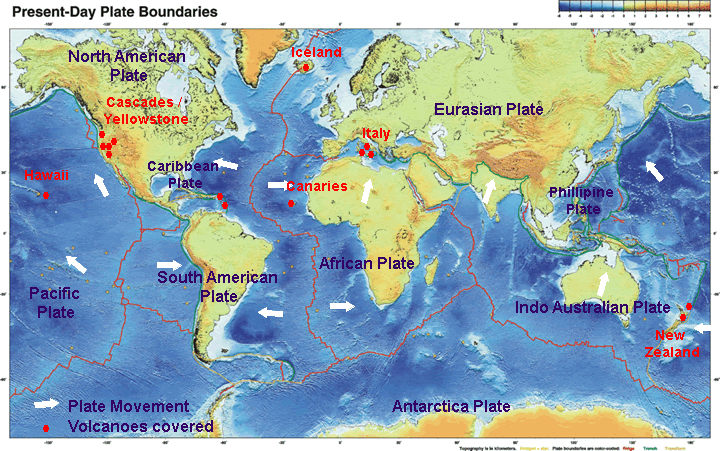
West of the Rockies the volcanic activity is due to the westward movement of the Pacific plate meeting the eastward movement of the Pacific Plate. At present a subduction zone where the Juan da Fuca plate is being subducted beneath the North American plate is producing the volcanics of The Cascades including the infamous Mt.St.Helens. The Yellowstone Caldera is a product of a Hot Spot underneath the continental crust and is potentially one of the worlds most dangerous volcanoes.

Hawaii is the jewel in the crown of the worlds volcanoes. The result of a Hot Spot or mantle plume beneath the Pacific plate which punches a hole through the crust and erupts out lava from the earths interior. Kilauea on Big Island has put on a continuous show of lava flows for decades and it is still going pouring lava into the sea.

Volcanic Lava flow in Hawai from the  Kilauea volcano.i Yellowstone super volcano . Volcanic Lava eruption from the summit of Mt.Etna Mt St helens volcano from Johnston ridge observatory Volcanic eruption  from Stromboli volcano , With  incandescent lava show at night.

Hawaii
Kilauea and
Pu oo oo

Yellowstone Supervolcano Mt .Etna Europes
largest volcano
Mt.St.Helens
Washington USA
Stromboli Lighthouse of The Med.
Explorevolcanoes.com. Online guide to  volcanoes in North America,Hawaii,Europe,New Zealand and the Carribean.  Volcanic Activity updates, volcano tour providers,volcano safety advice and  volcano educational material.Plate tectonics,types of volcano,volcano picture glossary and specialsied online volcano store.
Online volcano store
World wide Web Custom Search